
Can connectivity move with your team? Private 5G on the go
The limits of standard coverage in emergency operations
In July 2021 the Ahr, a small river in Rhineland-Palatinate, burst its banks. Floodwater and mud destroyed telephone exchanges, and the mobile network went down with them, in the very hours when rescue crews needed it (Fraunhofer FIT). The teams were on site. The connectivity was not.
Most networks are built around places: a tower on a hill, a cell covering a district, a fibre line running to a data centre. Teams follow the problem instead. A civil protection column drives to a flooded valley, a survey crew crosses a port, a search party climbs a slope where no operator ever planned coverage. So here is the practical question: can connectivity move with your team?
The short answer is yes, with limits worth understanding. This article looks at where mobile private networks are already used, what makes a network in motion hard to build, and how those problems are being solved.
Mobile private 5G glossary: key terms and definitions
Handover: the process of transferring a device's connection from one cell to another as it moves between coverage areas.
Backhaul: the connection that links a base station or access network to the core network, carrying traffic between them.
IAB (Integrated Access and Backhaul): a 5G technology that allows a node to provide radio access to devices while using a wireless link to connect to the network, reducing the need for fibre backhaul.
RACH (Random Access Channel): the procedure a device uses to contact a cell, establish uplink synchronisation and obtain the resources needed to start communication.
Conditional handover: a handover in which the target cell is prepared in advance and the connection is switched when predefined conditions are met.
RACH-less handover: a handover that avoids the usual RACH procedure at the target cell, reducing the time needed to complete the switch.
GNSS timing: timing information derived from satellite navigation systems such as GPS or Galileo, used to synchronise network nodes and keep their clocks aligned.
What "mobile" means in a private 5G network
A mobile private network is a 5G system packaged to travel: radio units, a core network, power, and a way out to the rest of the world. Picture a field hospital. It brings its own beds, generator and staff, and asks the outside for one thing only, a road. In network terms that road is the backhaul, the link between the local network and everything beyond it.
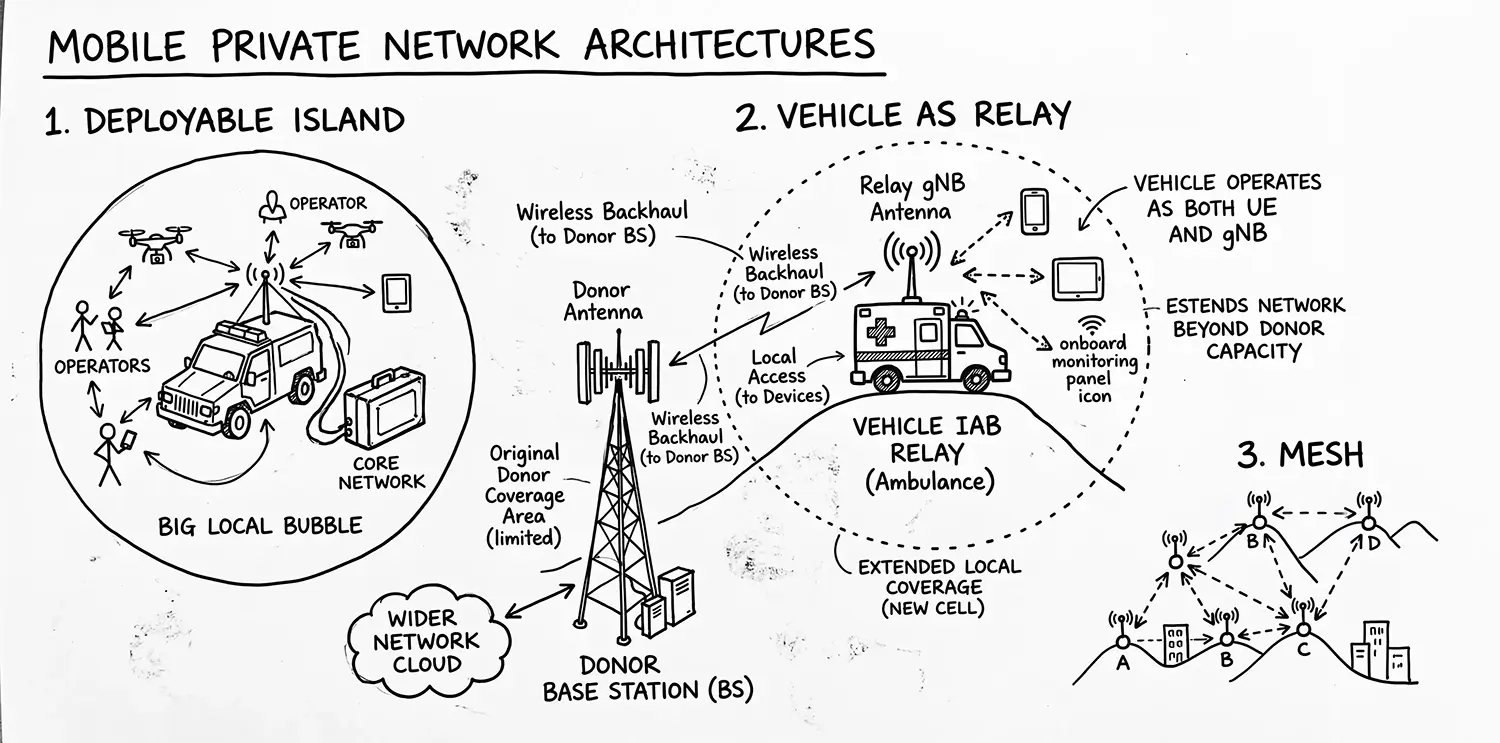
Three architectures cover most real deployments:
- The deployable island. Radio, core and power sit in a vehicle or a transport case. Because the core runs locally, everyone inside the bubble keeps talking even when the backhaul drops.
- The vehicle as relay. A base station on a vehicle roof reaches the wider network through its own backhaul link and serves the devices around it. From the outside the vehicle looks like a single node.
- The mesh. Small nodes relay for one another over several hops, so the network bends around hills and buildings without every unit needing a direct view of the base.
Why mobile 5G connections drop: handover, Doppler shift and backhaul limits
A fixed connection meets few of the problems that a moving one meets every minute, and most of them come down to a single word: change.
Handover. A device attached to one cell has to be passed to the next, and each pass is a moment where the link can stall or drop. As speed increases and cells become smaller, a moving device can trigger handovers more frequently, leaving less time to prepare the transition before the radio link degrades. Then comes the ping-pong effect, where a device flips repeatedly between two neighbouring cells, like a shopper who keeps switching supermarket queues and ends up slower than everyone else.
Doppler shift. Movement changes the frequency a receiver sees, which disturbs the tightly packed subcarriers of a 5G signal. It is the same effect behind an ambulance siren, higher pitched as it approaches, lower as it pulls away, except here the "pitch" is a radio frequency the network has to track. For high-speed train scenarios, 3GPP test conditions include Doppler shifts of 600 Hz at 300 km/h, and the effect becomes more pronounced at higher carrier frequencies. Why does a phone drop calls on a fast train while the same phone in a garden does not? Speed accounts for part of it. For a team on foot or a convoy at typical road speeds, Doppler is generally less challenging than it is for high-speed trains, aircraft or satellites, where it drives much of the design.
Vehicle penetration loss. A vehicle body can significantly attenuate radio signals, particularly when antennas or devices are located inside the cabin.
Blockage. Millimetre-wave links use narrow beams that a truck or a wall can interrupt in an instant.
Backhaul. A moving cell can only be as good as the link behind it. If that link is satellite, microwave or a public network, its own limits become the moving network's limits too.
Timing. Base stations usually take their clock from GNSS satellites, the way an orchestra follows a conductor. Where those signals cannot be trusted or received, the network needs a local reference instead, players keeping tempo among themselves, or it drifts out of sync with its neighbours.
| Problem | What causes it | Common response |
|---|---|---|
| Frequent handover | Speed and small cells force constant cell changes, with ping-pong between neighbours | Mobile relay, so the group stays attached while the relay changes donor cells |
| Doppler shift | Movement shifts the carrier frequency and disturbs subcarriers | Frequency correction in the receiver; a real concern mainly for trains, aircraft and satellites |
| Penetration loss | Vehicle bodies can significantly attenuate the signal, depending on frequency and vehicle design | Roof-mounted relay with the antenna outside the body |
| Blockage | Narrow millimetre-wave beams lose line of sight | Beam tracking, multi-connectivity, lower bands for the moving link |
| Backhaul | A moving cell depends on the link behind it | Several paths: mesh, microwave, satellite, public 5G, with failover |
| Timing | Base stations need a shared clock, usually from GNSS | Local high-precision clock where satellite signals cannot be trusted |
How mobile private networks handle handover and backhaul
How do you get an entire convoy to change cell together, without anyone in the vehicles noticing? The most effective answer is to stop asking every device to hand over on its own. Put a relay on the vehicle, and the devices inside connect to it while a single backhaul link moves between cells on their behalf. The antenna sits outside the body, so penetration loss shrinks too.
Integrated access and backhaul on the move
One standardized way to implement this architecture is integrated access and backhaul (IAB), where a node mounted on a vehicle acts as a small base station: it gives devices around it normal 5G access, and reaches the rest of the network through its own wireless backhaul link. We explored how access and backhaul work together in our dedicated article on IAB; the mobile variant extends the same principle to a node that keeps moving, handling its own handovers between donor cells so that the devices attached to it barely notice the change underneath them.
How to reduce handover latency in moving networks
Other mechanisms work alongside it.
Conditional handover prepares one or more candidate cells in advance, the way a relay runner already knows exactly where the baton exchange will happen instead of deciding mid-stride, so the device can execute the transition as soon as the configured conditions are met, reducing the risk of a late or failed handover.
RACH-less procedures go one step further, skipping the usual check-in queue because the boarding pass is already validated: they remove the need for a new random-access procedure during the handover, reducing signalling and execution time. And where no network reaches at all, devices can also relay through one another instead of relying entirely on fixed infrastructure, an approach explored for public-safety and disaster-response scenarios.
What is still unresolved
None of this is fully solved. The standards are moving forward, but practical deployments still have to bring together mobility, radio conditions, backhaul resilience and timing in the same field setup. An emergency communication system developed by Fraunhofer FIT, for example, uses mobile, self-organising network components to restore connectivity when conventional infrastructure fails. Elsewhere, hybrid connectivity has been tested where a device shifts between a locally deployed network and whatever commercial coverage remains, without the user noticing the switch. Both approaches solve part of the picture: local resilience in the first case, wider reach in the second, and neither replaces the need to plan for the other.
Where mobile connectivity matters: three settings, one recurring problem
The technical detail above is not academic. It shows up, in different combinations, wherever a team's location cannot be scheduled in advance.
Civil protection
When floods, fires or earthquakes damage local infrastructure, responders often arrive to find the coverage they expected simply is not there. A deployable network that carries its own core keeps working as an island even when everything around it is down, and every technique described above matters here: handover between nodes as vehicles move through the area, a backhaul that switches path when one link fails, timing that holds even without a reliable satellite signal.
Defence and tactical operations
In defence scenarios, spectrum visibility and reliance on external infrastructure can also become design considerations. This can increase the value of distributed architectures, redundant paths and local timing sources, depending on the operational environment. Field setups typically pair a mobile command post with mesh relays on the ground or on aerial platforms, and backhaul that can travel over satellite, radio links or whichever network happens to be available. Two extra constraints apply here. Timing has to hold even where GNSS signals cannot be trusted, which pushes designs toward local high-precision clocks. Radio emissions can also be detected and analysed, depending on the equipment and operational environment. This makes spectrum management, transmission characteristics and network architecture part of the wider design problem.
Training and simulation
Airsoft, MilSim and LARP events run on some of the same terrain that first responders later train on, woodland, abandoned buildings, disused military sites, and organisers already lean on connectivity for zone capture, team chat and live mission updates, with GPS kept optional because players cannot always look at a screen. A small private network on the same field could give organisers live positions and voice for every squad, and give responders training there a network shaped like the one they would actually use in the field. We have not found a documented private 5G deployment in this setting yet, so it reads as a scenario worth testing rather than an established use case, but the terrain and the constraints line up closely with the two settings above.
Mobile private 5G in practice: the SMA-RTY NGCI approach
SMA-RTY Italia develops NGCI (Next Generation Communication Infrastructure, a standalone private 5G infrastructure designed to be deployed wherever the team happens to be. One of its configurations integrates the radio and core network into a transportable case that can be set up in minutes. A demo built around IAB is currently in development, extending that same island toward the vehicle-relay model described above.
Moving connectivity rarely has a single technical answer. The right architecture depends on how the team moves, what has to keep working when the outside link fails, and which of the techniques above actually apply to the environment. Setup and configuration are adapted accordingly, so a search and rescue column, a defence unit and a training exercise can share the same underlying kit while running it in different ways.
Questions to settle before a network travels with you
Choosing among the options above starts with a handful of practical questions:
- How fast does the team move, and does it stay in one place long enough to set up a node?
- Where does the backhaul come from, and what is the second option when it fails?
- Does the network have to work when the outside world does not, or only work better than the public one?
- Which clock does the base station trust when satellite positioning is unavailable?
- Who else shares the site and needs to talk to your team: other agencies, partners, volunteers?
A mobile network is therefore not simply a fixed network put on wheels. Its architecture has to follow the way the team moves, the environment it operates in and the failures it has to withstand. When those constraints are understood first, the network can move with the mission rather than forcing the mission to move around the network.