
IAB 5G explained access and backhaul in one link
Every 5G network is made of cells, and every cell needs to be connected back to the core network somehow. For decades, that connection has almost always meant fiber optic cable. IAB, short for Integrated Access and Backhaul, changes that assumption, and it's becoming one of the key building blocks behind flexible, private, and mesh-capable 5G networks.
This article explains what IAB actually is, how it's built, and how it relates to mesh networking, a topic we cover in more depth in our companion piece, Mesh networks 101: how self-organizing nodes eliminate single points of failure.
What is Integrated Access and Backhaul (IAB)?
In plain terms, Integrated Access and Backhaul (IAB) is a 5G feature that allows a cell to connect to the core network wirelessly instead of using a physical fiber optic cable. It handles both user connections (the access link) and data routing to the core network (the backhaul link) over the exact same radio frequency.
To see why that matters, it helps to start with the problem it solves.
5G needs more cells, and fiber can't always follow
Higher 5G frequencies, particularly millimeter wave bands, travel shorter distances than the frequencies used by earlier generations of mobile networks. To get the same coverage, a 5G network needs a much higher density of cells packed closer together.
That creates a very practical problem. Every one of those cells traditionally needs a fiber connection back to the core network, and running new fiber is a bit like renovating a kitchen: it's rarely as quick, cheap, or straightforward as you'd hoped. In a lot of real-world situations, it's simply not possible at all: a temporary site, a ship, a disaster area, or a mobile operational perimeter isn't going to get a fiber trench dug for it.
Access and backhaul, over the same radio
Every 5G cell has two jobs: a way to talk to end-user devices, called the access link, and a way to send that traffic onward to the core network, called the backhaul link. Traditionally these have been treated as two separate jobs, requiring two separate types of connection.
IAB's core idea is to stop treating them as separate. Instead of requiring a dedicated fiber or microwave connection just for backhaul, an IAB node uses the same 5G radio to handle both jobs, serving users and relaying its own backhaul traffic over the air.
Think of a corridor in an office. Employees use it to move between rooms, and delivery staff use exactly the same corridor to bring in supplies. One corridor, two different purposes, no need to build a second hallway just to keep them apart. IAB does the same thing with radio spectrum.
Inside an IAB network: donor, nodes, and roles
An IAB network is generally built around two types of cells.
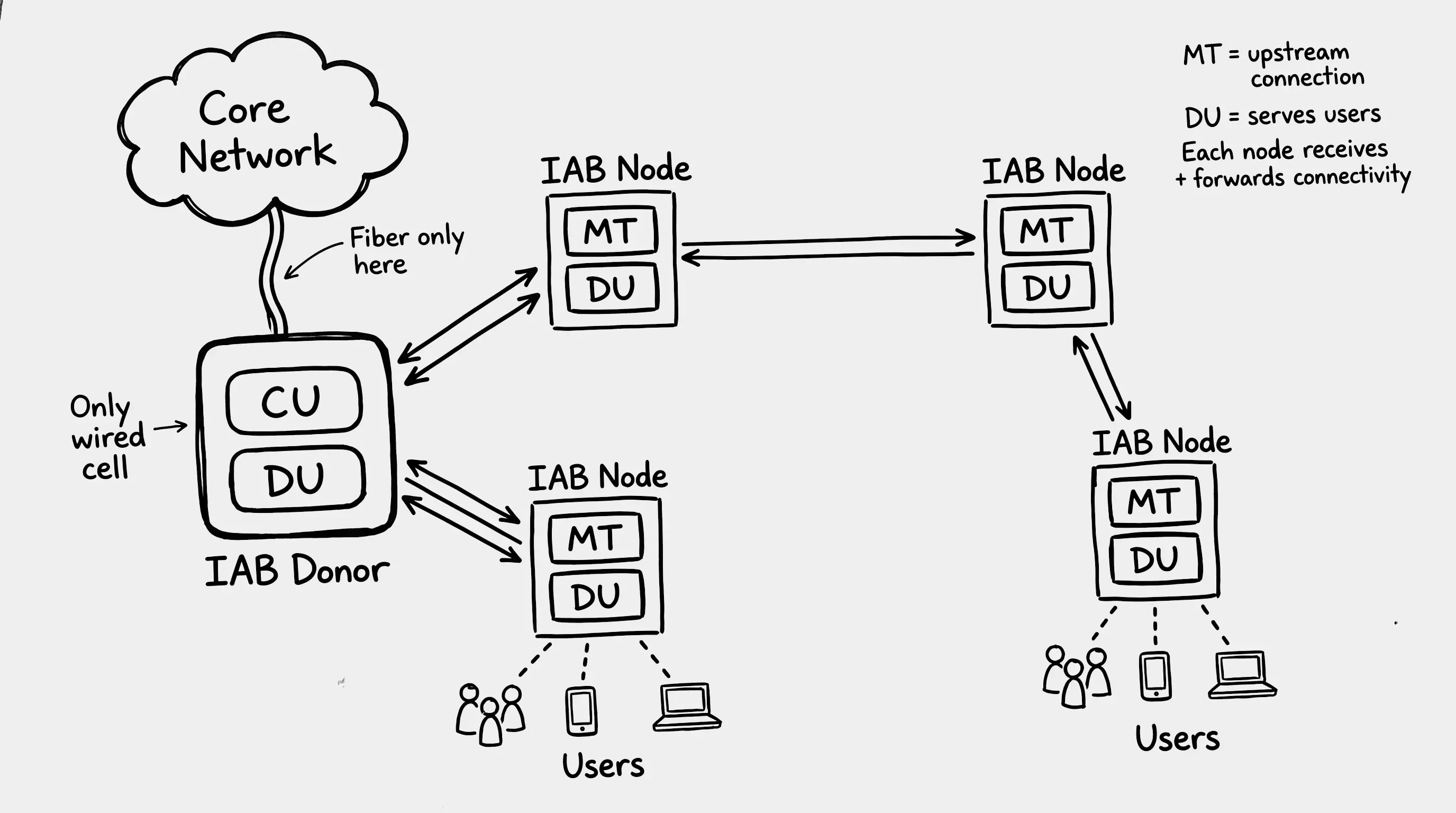
Think of the Donor as the one cell in the network that still has a physical cable running to it. Formally called the gNB Donor, it's the fixed point with a stable, direct line to the core network.
Every other cell has no fiber at all. These are the IAB Nodes, and each one connects wirelessly, either directly to the Donor or to another IAB Node one step closer to it, extending the chain outward.
What makes each IAB Node work is that it plays two roles at once. Toward the node above it in the chain, it behaves like an ordinary user device asking for a connection: this logical role is called the MT, or Mobile Termination.
Toward the users and nodes below it, the same IAB Node behaves like a base station, serving them directly: this role is called the DU, or Distributed Unit. In practice, every node is simultaneously "asking" for connectivity on one side and "providing" it on the other, which is exactly what lets the chain extend outward one hop at a time.
Making all of this route correctly requires an additional layer in the network's protocol stack, called the BAP, or Backhaul Adaptation Protocol. Its job is to figure out, at every hop, which direction a piece of data needs to go next, especially when a single IAB Node has more than one possible path back to the Donor. It works a bit like a package sorting center: every parcel arriving is read, matched to its destination, and routed onward along the most sensible path, without anyone needing to trace the entire journey in advance.
Is an IAB network automatically a mesh network?
Not quite, and it's a common point of confusion worth clearing up directly: IAB is a backhaul technology, not a network topology. Whether an IAB deployment behaves like a mesh depends entirely on how it's designed.
Single path IAB. In the simplest design, each IAB Node has exactly one route back to the Donor, forming a chain. This works, and it avoids fiber entirely, but it inherits the same weakness as any star-shaped network: if one link in the chain fails, every node downstream of it loses connectivity. The Donor, and every intermediate node, becomes a potential single point of failure.
Meshed IAB. In a more resilient design, IAB Nodes are deployed with more than one possible path back to the Donor, whether through other IAB Nodes or, in more advanced setups, through additional Donors. This is what actually makes the network behave like a mesh: if one link fails, the network can automatically reroute traffic through an alternative path, exactly the self-healing behavior described in our mesh networking article.
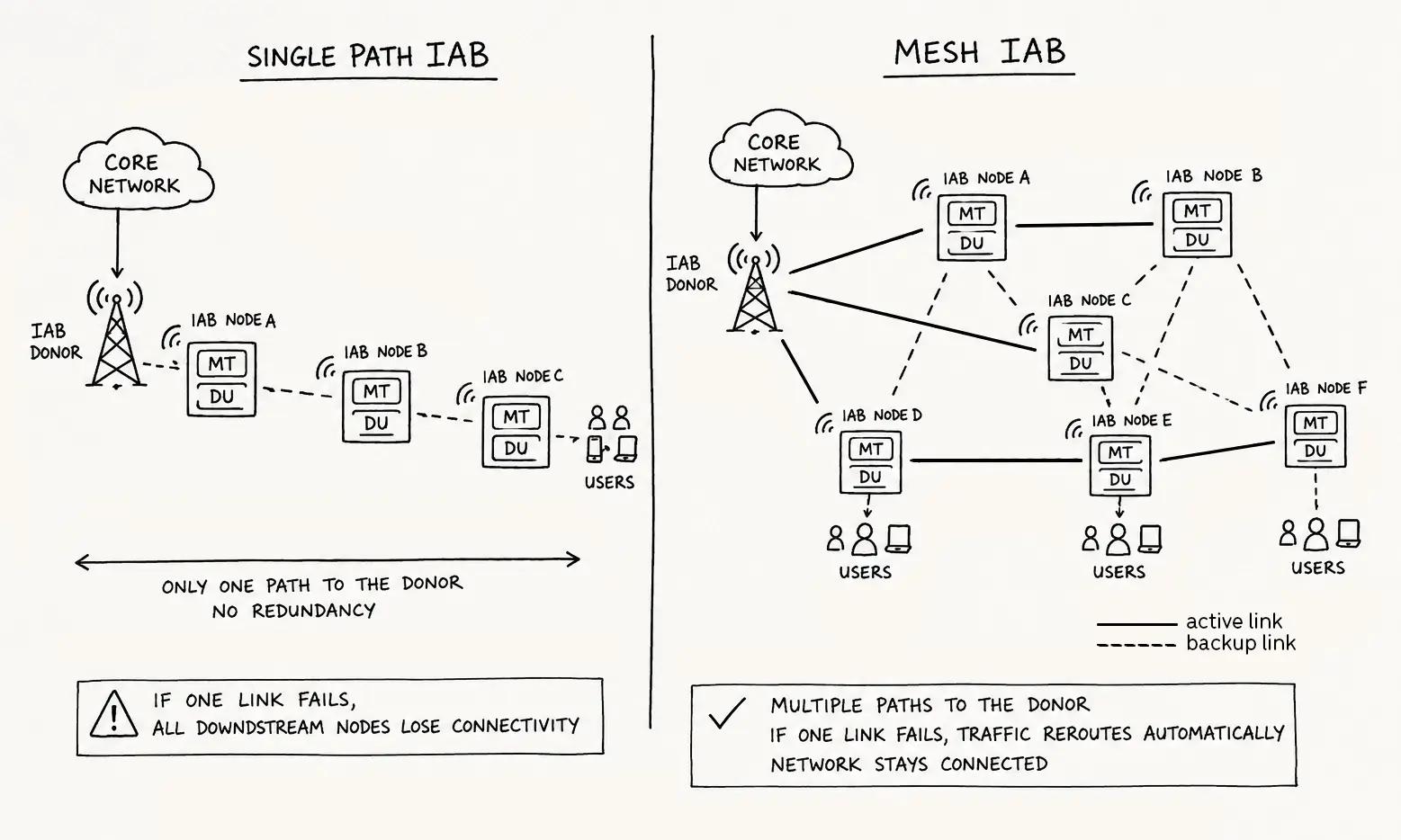
In short: IAB makes wireless backhaul possible. Mesh topology, layered on top of IAB, is what makes that backhaul resilient.
Primary use cases and deployment scenarios for IAB 5G
IAB was originally developed to solve a densification problem: how public 5G networks add capacity in busy urban areas without a fiber trench for every new cell. But the same properties that make it useful there, no cabling required, fast to deploy, easy to extend, make it just as relevant anywhere a network needs to reach a place that fiber can't easily follow: temporary installations, mobile operational areas, environments with limited or no fixed infrastructure, and private 5G networks that need to grow or move without a full re-installation every time. And every time a site does grow, someone eventually asks the same question: who's paying for the new cable? With IAB, that question doesn't come up.
The business benefits of IAB in private 5G networks
If you're evaluating a private 5G network, IAB is the detail that quietly determines how much your network will cost to install, and how easily it can grow later. A design that depends on fiber to every cell is a design that gets more expensive, and slower to deploy, every time the coverage area changes. IAB removes that constraint, and combined with a proper mesh topology, it removes the single point of failure too.
Key takeaways
- IAB (Integrated Access and Backhaul) lets a 5G cell handle both user connections and backhaul over the same wireless link, removing the need for a dedicated fiber connection.
- An IAB network is built from a fixed gNB Donor, connected by fiber, and wireless IAB Nodes that extend the network outward, each acting as both a user device (MT) and a base station (DU).
- The BAP protocol layer handles routing within the IAB chain, working much like a package sorting center.
- IAB is a backhaul technology, not a topology. It can be deployed as a simple single-path chain, or with redundant paths that make it behave like a true mesh network.
- Redundant, meshed IAB removes the single point of failure that a simple chain design would otherwise carry.