
Mesh Networks 101: How Self-Healing Works
Industrial Mesh Networks: How Self-Organizing Nodes Eliminate Single Points of Failure
If you've searched for "mesh network," chances are most of what you found was about home Wi-Fi systems: small boxes promising to kill dead zones in a living room. That's a valid use case, but it's a tiny fraction of what mesh technology actually does.
In critical sectors, an industrial mesh network is a decentralized wireless architecture where interconnected nodes cooperate to route data dynamically without relying on a central hub. Whether it's maritime logistics, defense operations, or emergency response, this architecture solves a very different problem: how do you keep communications alive when interference, moving assets, or shifting terrain are actively working against you?
This article breaks down what a mesh network really is, why it's more reliable than the alternative, and where this architecture consistently outperforms traditional fixed networks.
What is a mesh network, really?
Star vs. mesh: a quick comparison
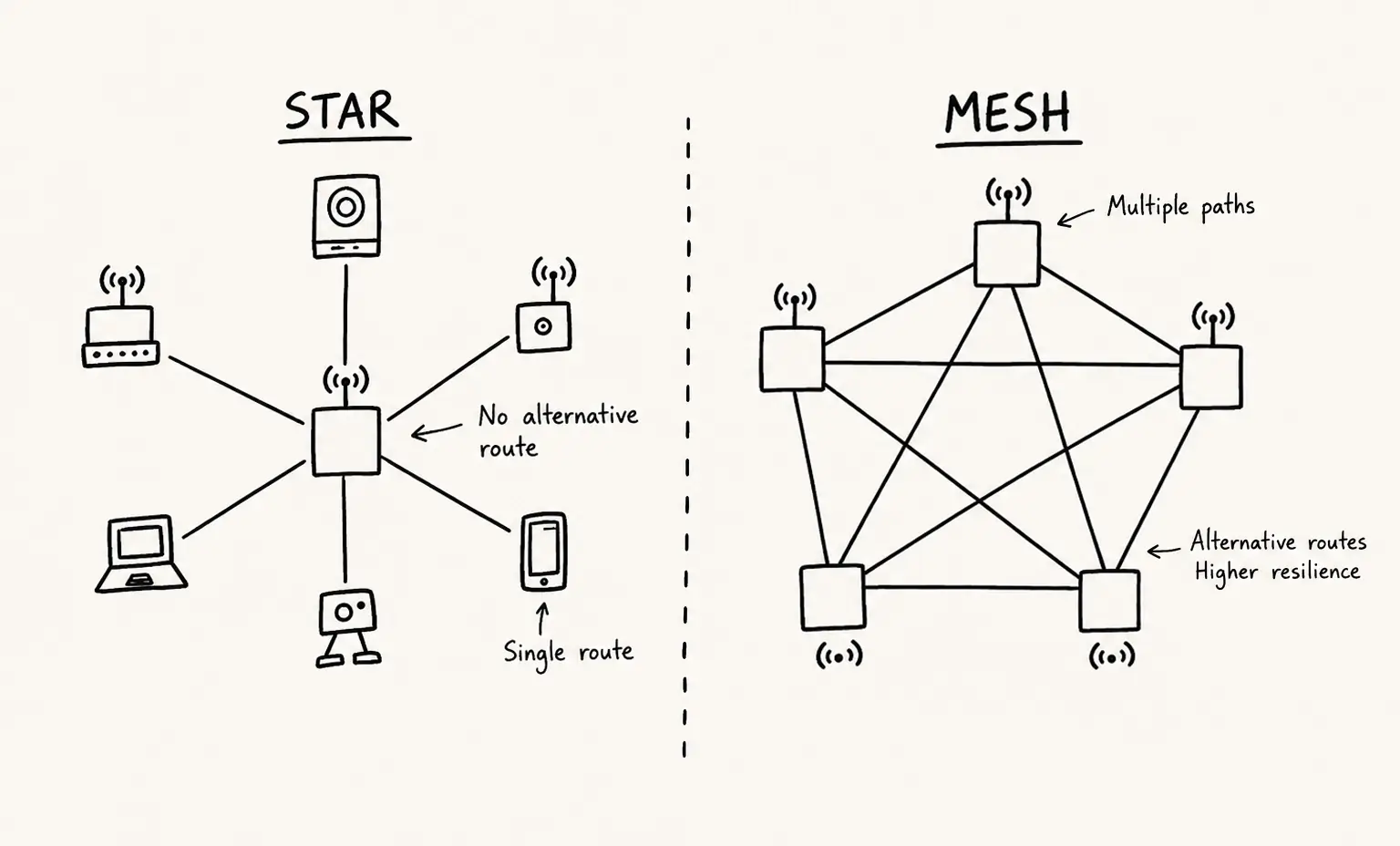
Most traditional networks, whether Wi-Fi, cellular, or wired, follow a star topology. Every device connects back to one central point: a router, an access point, a base station. It's simple and cheap to deploy, but it has an obvious weakness: if that central point goes down, or if a device is too far or too obstructed to reach it, connectivity is lost. No detours, no alternatives.
A mesh network removes that single point of dependency. Instead of every device talking only to a central hub, each node can also talk to its neighboring nodes. The network becomes a web of interconnected paths rather than a single spoke and wheel structure.
Every node is also a relay
In a mesh architecture, a node isn't just an endpoint receiving a signal, it's also a relay, capable of forwarding traffic on behalf of other nodes. A sensor, a vehicle, or a fixed access point can all double as intermediate hops. This is what's known as multi-hop communication: data doesn't need a direct line to its destination, it can travel node to node until it gets there, a bit like a message passed hand to hand through a line of people rather than shouted across a stadium.
The practical effect is coverage that extends organically. Instead of one powerful, and expensive, transmitter trying to reach everywhere, many smaller nodes cooperate to cover the same area, often more reliably.
Is Mesh a Network Topology or a Radio Technology?
This is a point worth being precise about, because it's easy to get wrong: "mesh" describes how a network is organized, not what radio technology it runs on. The principle, every node can also act as a relay, and if one node fails the traffic finds another path, doesn't belong to any single technology. It's an idea that can be applied to almost any kind of wireless transmission.
That's why mesh networks show up in very different forms: mesh Wi-Fi systems for homes and offices, mesh radio used in military and tactical communications, LoRa mesh for long-range, low-power sensor networks, satellite mesh constellations, and, increasingly, mesh networks built on 5G.
Is IAB the same thing as a mesh network?
If you've come across the term IAB (Integrated Access and Backhaul) while researching mesh networks, it's worth clarifying the relationship, because the two are often mentioned together but aren't the same thing.
Integrated Access and Backhaul (IAB) is a specific 5G feature standardized by 3GPP that connects a cell to the core network over a wireless link instead of fiber. Consequently, IAB functions as a backhaul mechanism rather than a native network topology.
So IAB is not a type of mesh network. It's an enabling technology that can be used to build a mesh network, but doesn't automatically create one. An IAB deployment can be arranged as a simple chain, where each cell has only one path back to the network, or it can be arranged with redundant paths between nodes, which is what actually makes it behave like a mesh, with the self-healing properties this article covers.
We go into exactly how IAB works, and how the two topologies compare, in a dedicated article: IAB explained, access and backhaul in one wireless link.
Why are mesh networks more reliable?
The short answer is self-healing, and it's far more than just a marketing buzzword. Hardware has an inconvenient habit of failing at the worst possible moment, turning theoretical uptime into a real-world crisis.
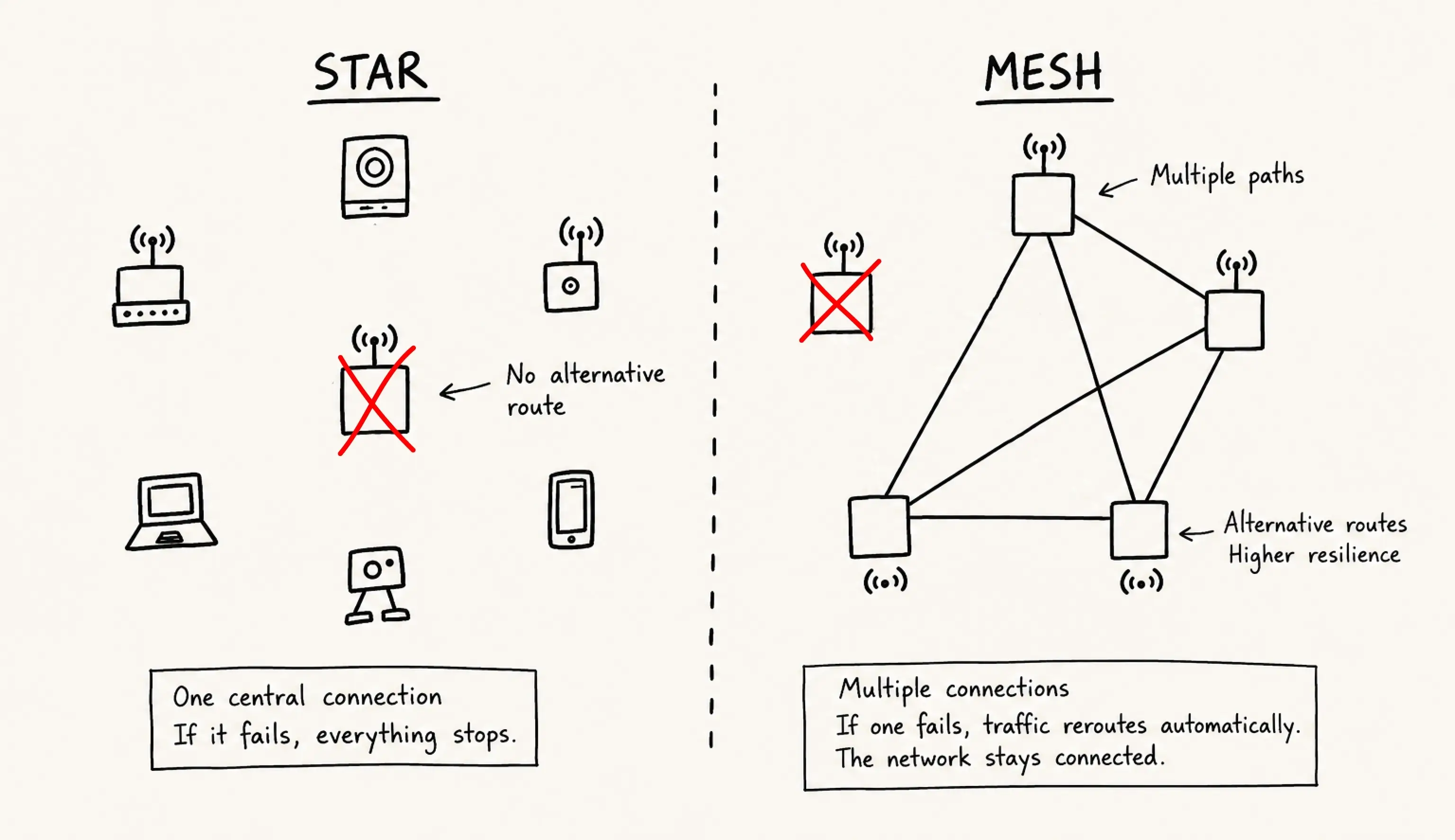
In wireless routing, self-healing is the automated, real-time rerouting of data traffic around failed, moving, or physically obstructed nodes without manual intervention.
To understand how this works in practice, look at the contrast: while a traditional star topology suffers a total blackout if its central hub goes down, a mesh network simply recalculates. Because the architecture is decentralized, each individual node continuously monitors the quality and availability of its neighboring links—tracking metrics like signal strength, packet loss, and congestion. When a specific path becomes unavailable, the network doesn't wait for a technician; it instantly shifts traffic to the next best available route.
Dynamic routing protocols in practice
This happens through routing protocols that constantly evaluate the network's topology: which nodes are reachable, what's the signal quality, how many hops does a given path require. Some protocols work proactively, keeping routing tables updated at all times; others work reactively, calculating a path only when data actually needs to be sent. Either way, when conditions change, routes are recalculated in real time, typically within milliseconds to a few seconds depending on the protocol and the size of the network.
The result is a network that degrades gracefully instead of failing catastrophically. Losing one node might mean a slightly longer path, and a few extra milliseconds of latency, for some traffic. It doesn't mean a blackout.
What are the advantages of a mesh network?
Pulled together, the case for mesh comes down to a handful of practical advantages:
- Reliability. No single point of failure; the network reroutes itself automatically when something breaks.
- Scalability. Coverage extends by adding nodes, not by re-engineering the whole system.
- Resilience to interference. Traffic can route around physical obstacles instead of simply failing.
- Flexibility. Nodes can move or be repositioned as operations evolve, without new cabling.
Where mesh networks outperform fixed infrastructure
Dynamic and Fast-Changing Operational Environments
Some operational environments are inherently dynamic. Think of a large infrastructure project that expands section by section, an emergency response area where teams and vehicles move constantly, or a temporary operational perimeter set up for an exercise or a mission. In these scenarios, the area that needs connectivity rarely stays the same for long.
Fixed infrastructure struggles here because it assumes stability: cabling, fixed antenna positions, permits, physical access.Fixed infrastructure assumes the environment won't change. Reality is often less cooperative. Every change to the environment means a change to the network, often requiring new installation work. A mesh network, by contrast, extends naturally: adding a node extends coverage without re-engineering the entire system, and nodes can be repositioned as operations evolve.
Overcoming Wireless and Physical Signal Interference
Other environments are stable but physically hostile to wireless signals. Dense metal structures, like warehouse racking, can create pockets of signal blockage, sometimes informally described as a "Faraday cage effect," where a wireless device that worked fine one aisle over suddenly struggles to find a signal. Large bodies of water introduce reflection and reverberation that distort standard radio propagation. Underground or heavily built environments create similar blind spots.
In a star topology, this often means dead zones with no easy fix short of adding infrastructure. In a mesh topology, the network can route around the obstruction, using nearby nodes as relays to maintain connectivity in exactly the spots where a single access point would fail.
Common misconceptions about mesh networks
"Mesh means slower," when it's true and when it isn't
It's true that every additional hop introduces some latency, and that multi-hop paths can, in theory, reduce throughput compared to a direct connection, since each relay has to receive and retransmit the same data, competing for the same radio spectrum. This is a real engineering trade-off, and it matters more in some use cases (real-time video, tactical data) than others.
But this isn't a fixed law, it depends heavily on the network's design: how nodes are placed, how many hops a typical path requires, which frequency bands are used, and how the routing protocol prioritizes traffic. A well-engineered mesh, sized correctly for its environment, can deliver performance well within the requirements of demanding, real-time applications.
The "mesh is slow" reputation mostly comes from underpowered consumer-grade systems, not from architectures designed for industrial or mission-critical use.
Consumer mesh Wi-Fi vs. industrial and private mesh networks
This is probably the most important distinction to make, and the one most search results won't clarify. Consumer mesh Wi-Fi systems are designed to solve a narrow, low-stakes problem: extend home coverage without running new cable.
Industrial and private mesh networks are a different category of engineering. They're built to operate over larger distances, integrate multiple types of nodes (fixed, mobile, aerial, underwater), meet strict security and control requirements, and keep operating reliably under real physical stress: vibration, temperature extremes, electromagnetic interference, or intentional disruption.
The underlying principle (self-organizing, multi-hop, self-healing) is the same. The engineering behind it, and what's at stake if it fails, is not.
Multi-domain scenarios: when mesh meets land, sea, and air
The most advanced applications of mesh networking today go beyond a single environment. Modern operations, whether industrial, maritime, or defense-related, increasingly need to connect assets across different domains at once: ground vehicles, fixed sensors, aerial drones, surface or underwater platforms, all exchanging data as part of the same operational picture.
This is where mesh architecture becomes less of a convenience and more of a requirement. A network that can only handle one type of node, in one type of environment, simply isn't built for how modern operations actually work.
Multi-domain connectivity, coordinating communication across land, sea, and air within a single resilient network, is one of the fastest-growing frontiers in private wireless infrastructure, and it's built on exactly the principles covered in this article.
The Value of Mesh Networks in Mission-Critical Operations
If you're managing a home Wi-Fi network, mesh is mostly about convenience: fewer dead zones in the living room.
If you're managing a factory, a construction site, an emergency response operation, or a fleet of autonomous vehicles, it's about something much simpler: keeping people and systems connected when failure isn't an option.
Key Takeaways: Industrial Mesh & Self-Healing Networks
- Mesh Network vs. Star Topology: A mesh network eliminates single points of failure by replacing traditional star topologies with a decentralized web of interconnected nodes capable of multi-hop communication.
- Topology vs. Technology: Mesh describes a network architecture, not a specific radio standard. It can be deployed across diverse wireless technologies including Wi-Fi, LoRa, satellite constellations, private 5G, and tactical radios.
- 5G IAB vs. Mesh: 3GPP Integrated Access and Backhaul (IAB) is a wireless 5G backhaul mechanism, not a native topology. However, IAB nodes can be arranged in a redundant layout to enable a self-healing mesh behavior.
- Definition of Self-Healing: In wireless routing, "self-healing" refers to the automated, real-time rerouting of data traffic around failed, moving, or physically obstructed nodes without requiring manual technical intervention.
- Industrial Deployment: Mesh architecture consistently outperforms fixed infrastructure in dynamic operational environments with fast-moving assets and settings prone to heavy physical or electromagnetic signal interference.
- Consumer vs. Industrial Mesh: While multi-hop latency is a factor, industrial-grade private wireless mesh utilizes advanced routing protocols and ruggedized hardware to deliver mission-critical performance that consumer home Wi-Fi systems cannot match.
- Multi-Domain Connectivity: The frontier of private wireless infrastructure lies in multi-domain mesh networks that seamlessly coordinate data exchange across land, sea, and air assets within a single, resilient operational picture.