Digital Twins: seeing reality isn't enough
Digital Twins: Why Seeing Reality Isn't Enough
Manufacturing plants, construction sites, ports, power grids, and even entire cities are becoming increasingly data-driven. Every second, thousands of sensors record temperatures, vibrations, positions, energy consumption, weather conditions, and countless other variables. Individually, these measurements don't tell much of a story. Together, they describe how an entire system is behaving.
Or at least, they should.
Imagine a large automated warehouse where a section of the conveyor belt begins to draw slightly more power than usual. Nothing dramatic. It still moves, packages flow, and no alarm goes off. Over the following weeks, that energy consumption slowly creeps up while the friction on a specific bearing increases by just a fraction. Each change is too small to trigger attention on its own.
Then, during peak hours, the belt jams unexpectedly.
To the logistics team, the failure seems sudden. In reality, the warning signs had been there for weeks.
A digital twin is designed to notice that story long before people do.
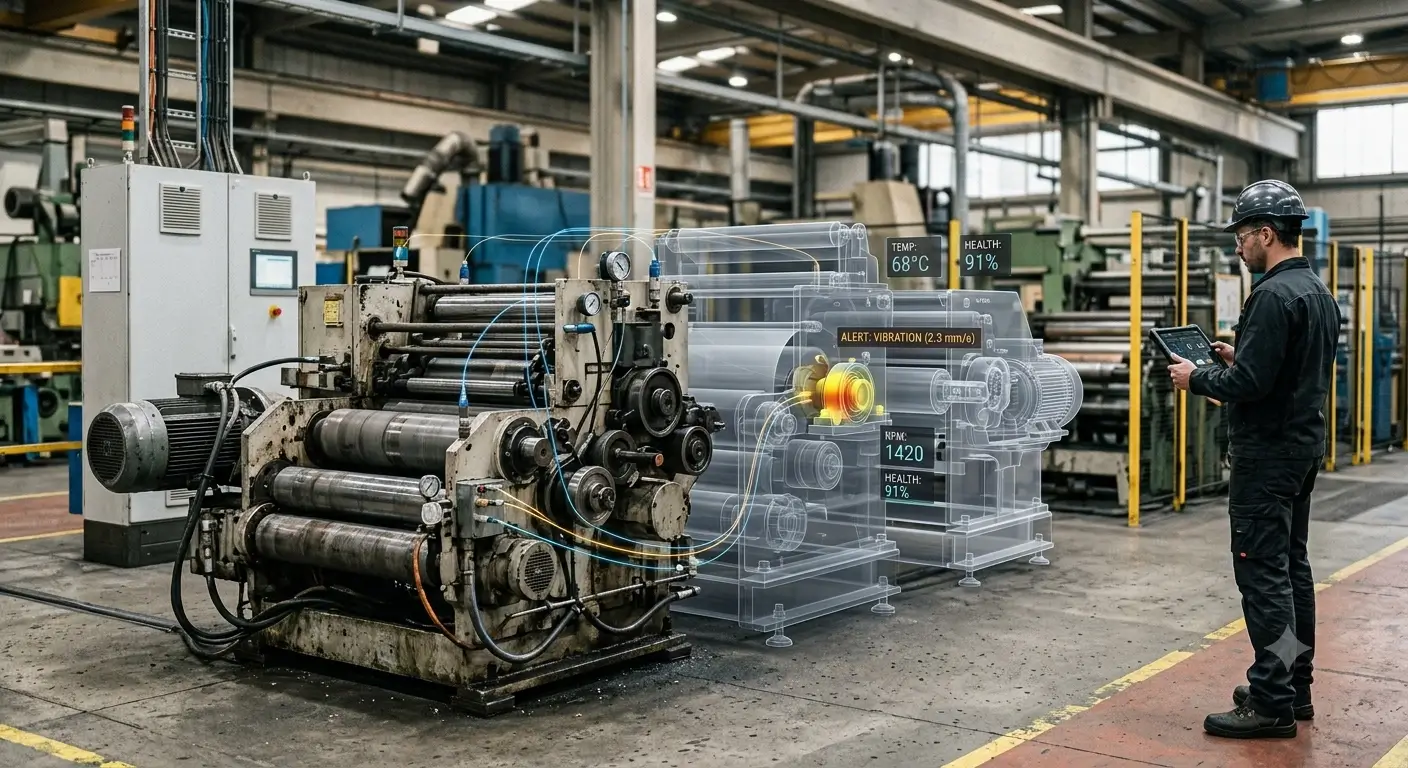
Unlike a drawing, a CAD model, or even a simulation, a digital twin continuously evolves alongside its physical counterpart. Its purpose isn't simply to visualize reality. It's to understand it.
More Than a Simulation
The term digital twin is often used interchangeably with simulation, but they are not the same thing.
A traditional simulation starts with assumptions. Engineers define the conditions, run the model, observe the results, and stop the simulation. It answers questions like: "What would happen if...?"
A digital twin operates on a different logic. Instead of relying on static assumptions, it continuously ingests real-time sensor data from the physical world. Sensors stream measurements into the model, allowing it to reflect what is actually happening rather than what engineers expected to happen.
Think of it like this:
- A CAD model is a blueprint. It shows how something was designed.
- A simulation is an experiment. It predicts what could happen under specific conditions.
- A digital twin is a living model. It constantly adapts as the real system changes.
This continuous synchronization is what transforms a digital model into a decision-making tool. Instead of analyzing yesterday's conditions, operators can monitor what is happening now, anticipate future behavior, and react before small anomalies become costly failures.
Why Real-Time Connectivity is Critical for Digital Twins
The real value of a digital twin doesn't come from having a beautiful 3D model on a dashboard. It comes from timing.
Imagine opening a navigation app while driving. If the map updates every few seconds, it can guide you around traffic, road closures, or accidents. But if it only refreshed every five minutes, you would probably find yourself stuck in traffic it should have warned you about. A digital twin works exactly the same way.
If the information arriving from the physical world is delayed, incomplete, or interrupted, the virtual model slowly drifts away from reality. Over time, predictions become less accurate. Maintenance is scheduled at the wrong moment. Automated systems react to outdated information.
In other words, a digital twin doesn't become useless because the model is wrong. It becomes useless because the model is no longer synchronized with the world it is supposed to represent.
Perhaps the easiest way to think about a digital twin is not as a model, but as a conversation. On one side is the physical asset reporting what it sees; on the other side is the virtual model listening, processing, predicting, and sending instructions back. As long as that conversation continues uninterrupted, the twin remains an accurate reflection of reality.
The Three Layers Behind Every Digital Twin
A digital twin may look like a software application, a 3D visualization, or a dashboard full of data. But behind the interface, there is something much more complex. Every digital twin is built on three fundamental layers working together:
1. The physical layer: where reality begins
Everything starts with the physical world. This is the asset, environment, or process that the digital twin is designed to replicate. Sensors, cameras, industrial devices, and connected equipment continuously collect information about what is happening (e.g., temperature changes, vibration patterns, pressure variations, energy consumption). The physical layer is where the story begins. But it is only the beginning.
2. The connectivity layer: the bridge between reality and the model
Between the physical asset and the digital twin there is the network. The connectivity layer is responsible for transporting all the information collected by sensors into the digital environment. Without this bridge, even the most advanced AI model has nothing to work with. The network determines how quickly information reaches the model, how much data can be transmitted, and whether communication remains stable in difficult environments.
3. The virtual layer: turning data into decisions
This is the digital representation of the physical asset. But the real value of this layer is not visualization—it is interpretation. The virtual model combines incoming data with historical information, analytics, and AI to answer important questions like: Is this machine operating normally? What action should be taken next?
The Core Maturity Levels of Digital Twins: From Monitoring to Autonomy
Not all digital twins are equally advanced. The term covers a wide range of applications, from simple digital representations to highly autonomous systems capable of influencing the physical world. While some technical frameworks begin with a purely static baseline, the operational evolution of a connected digital twin can be best understood through four core maturity levels.
| Level | What it does | Everyday equivalent |
|---|---|---|
| Descriptive twin | A digital representation of an asset, based mainly on static information such as drawings, models, or documentation. | A photograph |
| Informative twin | Adds real-time data from sensors, allowing users to see current conditions. | A video call |
| Predictive twin | Combines live data with simulations and analytics to forecast future behavior. | A weather forecast |
| Autonomous twin | Can trigger actions or adjustments in the physical environment without direct human intervention. | A smart thermostat |
The Real Challenge: Keeping the Twin Synchronized
Building a digital twin is not simply about creating a detailed digital copy. The difficult part is maintaining the connection between that copy and reality. The physical world is dynamic. A digital twin must be dynamic as well.
This is why the quality of a digital twin is ultimately measured by one question: How accurately does it represent what is happening right now?
And answering that question brings us back to the most underestimated component of the entire system: the network. Because a digital twin is not a static copy of reality. It is a constantly updated representation. And keeping that representation accurate requires more than collecting data. It requires moving that data reliably, quickly, and securely.
The hidden cost of latency
In everyday life, network delays are mostly an inconvenience. In industrial and mission-critical environments, the consequences can be very different. Imagine an autonomous vehicle operating inside a large warehouse. The virtual model is expected to represent what is happening in real time. But industrial environments are not always friendly places for wireless communication. Metal structures can reflect signals. Machinery can create interference. The result? The model is slowly drifting away from reality. It is no longer showing what is happening. It is showing what happened.
Why traditional networks struggle in complex environments
Public wireless networks are designed to serve a wide variety of users and applications. However, many industrial and mission-critical scenarios have very different requirements:
- Low latency: Information must travel quickly between physical devices and the digital model.
- High reliability: The connection must remain available even when conditions are challenging.
- Dedicated performance: The communication channel must be designed around operational needs.
- Flexible deployment: The network must adapt with the environment.
These requirements are exactly where private 5G and mesh networking become relevant.
Private 5G & Mesh Networking
A private 5G network creates a dedicated connectivity environment designed around a specific operational scenario. Instead of relying on a shared public infrastructure, organizations can deploy their own network with controlled coverage, performance, and security. The value of private 5G is not simply that it is "faster". The real advantage is control.
However, dynamic industrial environments require adaptable connectivity. This is where mesh networking adds a critical layer of reliability to a private 5G infrastructure. In a mesh network, nodes cooperate with each other. If one connection becomes unavailable, data can find another path. The network can reorganize itself around obstacles or failures, maintaining communication even when conditions change.
When private 5G and mesh networking are combined, connectivity becomes more than a data transport mechanism. It becomes an enabling infrastructure for real-time intelligence.
Industrial Use Cases for Digital Twins
Digital twins are already becoming part of everyday industrial operations. The goal is always the same: create a reliable connection between the physical world and a digital representation of that world.
- Manufacturing: Shifting from corrective maintenance to predictive maintenance by identifying unusual patterns before they become failures.
- Ports and maritime environments: Providing a live representation of moving ships, cranes, and autonomous vehicles across complex operational areas.
- Construction sites: Comparing real progress with original plans in a constantly evolving physical environment.
- Emergency response: Creating a shared operational picture when traditional communication infrastructure is unavailable.
- Cybersecurity: Simulating cyberattacks and evaluating vulnerabilities in a safe virtual environment.
Key Takeaways
- A digital twin is a virtual representation of a physical asset that remains synchronized through continuous data exchange.
- The quality of a digital twin depends on the quality of the data it receives. Delayed or unreliable data creates an outdated representation of reality.
- Connectivity is not a secondary component: it is the foundation that allows the digital twin to operate in real time.
- Private 5G and mesh networking provide the reliability, flexibility, and resilience required for complex environments.
Creating a successful digital twin starts with a simple question: What decisions do we want to improve, and what information is needed to make those decisions?
The future of digital twins will not be defined only by better models or smarter algorithms. It will depend on the ability to keep the physical and digital worlds connected.