
Real-time data: how to improve Rolled Throughput Yield
A component drifts slightly out of tolerance at station 2. Nothing flags it. The part moves to station 3, then 4, then 5 and 6, accumulating more work at every step. Only at final inspection does someone detect the deviation.
At that point, the problem isn't just one defective part. Several stations have already spent time, energy and labor processing a component that should have been stopped much earlier. That gap, between when a deviation occurs and when it is detected, is where Rolled Throughput Yield (RTY) becomes useful.
It shifts the question from how many defective units did we find? to how many units made it through the entire process right the first time?
What rolled throughput yield actually measures
Rolled throughput yield (RTY) is the percentage of units that pass through every stage of a process without defects or rework. Unlike a simple average, RTY is calculated by multiplying the first-pass yield of each individual station.
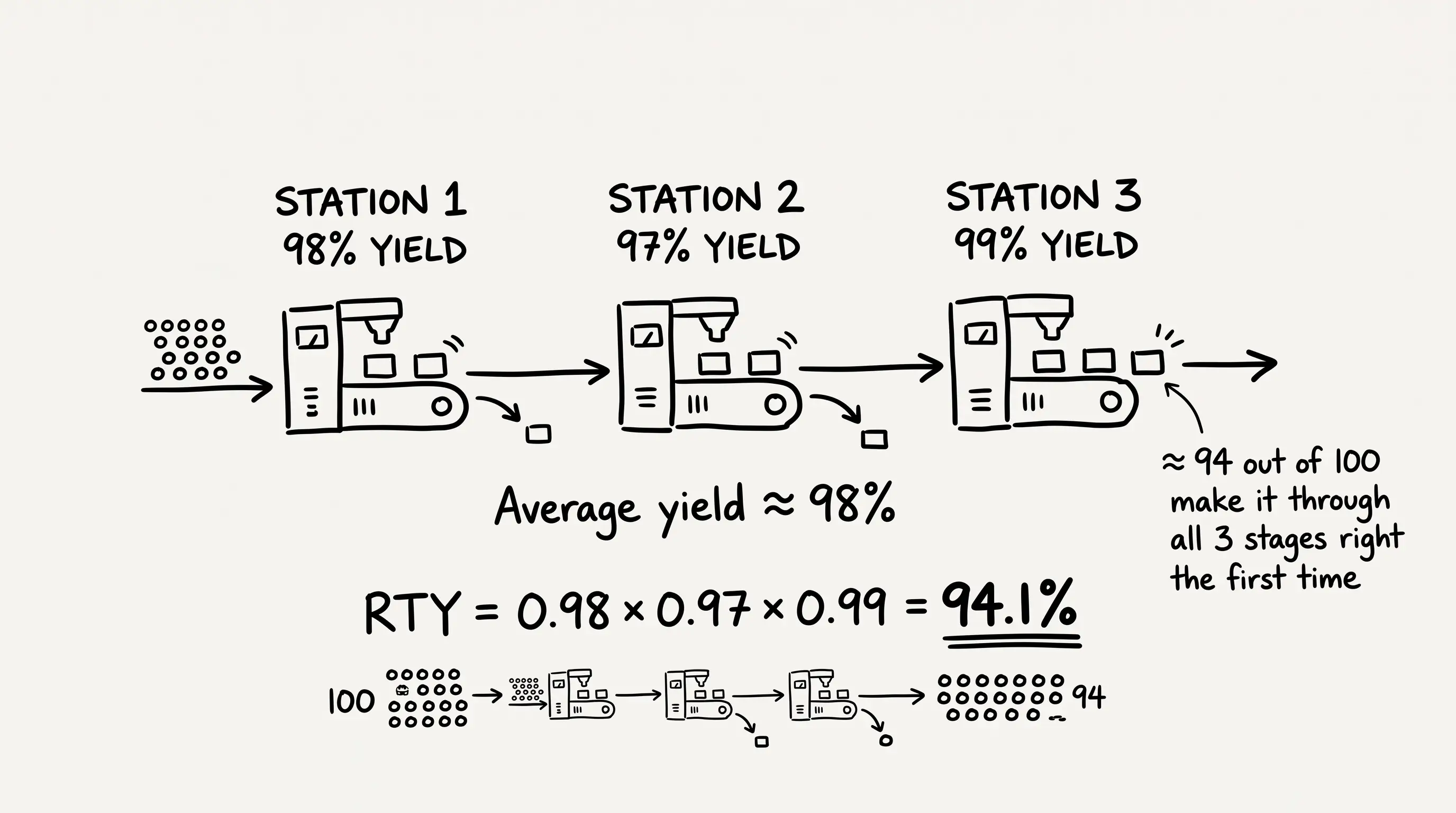
Take a line with three stations:
- Station 1: 98% yield
- Station 2: 97% yield
- Station 3: 99% yield
The average yield is 98%. The RTY, on the other hand, is:
0.98 × 0.97 × 0.99 = 94.1%
So while every individual station appears to perform above 97%, only about 94 out of 100 units make it through all three stages right the first time. That's what makes RTY valuable: it exposes the cumulative effect of small losses that look insignificant when each station is considered on its own.
Why RTY asks a different question than scrap rate
Scrap rate tells you how much material or product was ultimately discarded. RTY asks a different question: how much of the production actually flowed through the process without needing correction?
Imagine 100 units moving through a line. Some are scrapped along the way. Others reach final inspection, get flagged as defective and go back for rework. Those reworked units may never appear in the scrap figures, but they've already consumed machine time, energy, materials, operator hours and production capacity.
The cost of a defect, in other words, isn't necessarily the moment a product gets scrapped.
The earlier a deviation is detected, the less downstream work is performed on a product that may ultimately need correction.
Root causes of Rolled Throughput Yield (RTY) losses
Not all defects behave the same way, and that's part of why sampling-based QA struggles to catch them. Some are easy to see once you know where to look. Others aren't visible at all under normal conditions.
- Dimensional drift: a fastener torqued slightly out of spec, a part positioned a few millimeters off. Individually tiny, but enough to fail downstream assembly.
- Surface and cosmetic defects: scratches, finish inconsistencies, contamination on a surface that should be clean. Often only visible under specific lighting or magnification.
- Thermal anomalies: a component running hotter than it should, an early sign of a connection about to fail, invisible to a standard camera and often to the naked eye entirely.
- Misalignment and placement errors: a component seated at a slight angle, a connector not fully seated. These can pass a quick visual check and still cause a failure two stations later.
- Contamination hidden from view: residue, moisture or particulate trapped under a surface, behind smoke or vapor in the work area, where standard visible-light imaging simply can't see.
Why do these slip past standard checks? Because a sample inspection only catches what happens to be true of the unit it happens to look at, at the exact moment it looks. A drift that starts mid-shift can run for hours before the next scheduled sample catches it, and by then it isn't one unit anymore.
Multispectral vision: catching defects standard checks miss
Closing that gap means matching the sensor to the failure mode, not using one camera type for every problem. This is where SMA-RTY France, the group's sister entity focused on multispectral vision and embedded AI, becomes directly relevant to the RTY conversation.
Dimensional and placement errors on a fast-moving line call for a high-speed, high-precision eye: ASB-1080 Mono, a monochrome global shutter camera built for industrial vision, is designed for exactly that kind of frame-by-frame accuracy without motion blur.
Thermal anomalies need a different sense entirely: THR-LW Thermal, an HD shutterless LWIR camera with sub-60mK sensitivity and real-time FPGA processing up to 60 FPS, can flag a component running hot before it becomes a failure, not after.
And for contamination or defects obscured by smoke, vapor or certain plastics, where visible light imaging hits a wall, FNX-SWIR uses a shortwave infrared sensor to see through conditions a standard camera can't, a capability still in early integration but built for exactly this kind of blind spot.
None of these replace a human inspector. What changes is when the information becomes available: at the moment the deviation happens, station by station, instead of a spot check hours later.
Detection is only useful if the information reaches the right person, or the right system, before the next unit does.
Private 5G: transmitting real-time alerts without latency
A line rarely runs one camera. It runs several, each watching a different station for a different failure mode, and each one generating a continuous stream of data that has to move somewhere useful without delay. That's a bandwidth and reliability problem as much as a vision problem.
On a shared network carrying unrelated plant traffic, a time-sensitive alert can end up competing for capacity with information that has no operational urgency at all. A private 5G network such as NGCI is built to avoid exactly that: deterministic latency and a control plane that stays inside the plant's own perimeter, so a detection from station 2 doesn't sit in a queue behind traffic that has nothing to do with the line. The point isn't just connecting more cameras. It's making sure that when one of them sees something, the alert gets where it needs to go before the next unit has already moved past the same station.
Edge AI: turning multi-sensor streams into real-time yield control
Multiple cameras watching multiple stations produce more data than any operator can watch directly, which is where the interpretation layer earns its place in the chain. On the edge processing side, hardware such as BNX Carrier, built around NVIDIA Xavier NX and Orin NX for on-site AI processing, can aggregate data from several MIPI camera feeds at once rather than treating each one as an isolated alert.
An embedded AI module like BASEN operates at this edge layer: it categorizes deviations by determining whether an anomaly requires an immediate line stop or continuous logging. That distinction is what keeps a real-time detection system useful instead of noisy. A line that stops for every minor fluctuation is its own kind of yield problem.
Expanding real-time sensing: positioning and safety via Private 5G
The same architecture applies wherever a system needs to respond to a changing physical environment. SMA-RTY's 5G-SHIELD project, for example, combines 5G mmWave connectivity, data fusion and augmented reality to support safer operations in loading and unloading areas, where the position of equipment and personnel can change continuously.
The application is different from production-line quality control, but the underlying principle is the same: real-time perception creates value only when the information can move fast enough to support a decision.
Key takeaways for Rolled Throughput Yield optimization
RTY doesn't just tell a plant how many units failed. It reveals how small losses at individual stages accumulate across the entire process. Improving it isn't only about finding more defects. It's about matching the right sensor to the right failure mode, communicating what it finds reliably, and understanding what it means before deciding what to do about it.
The goal is simple: catch the problem while it's still one unit, not a batch.