
Etna, drones and private 5G: building adaptive connectivity
A volcano that will not sit still: connectivity challenges
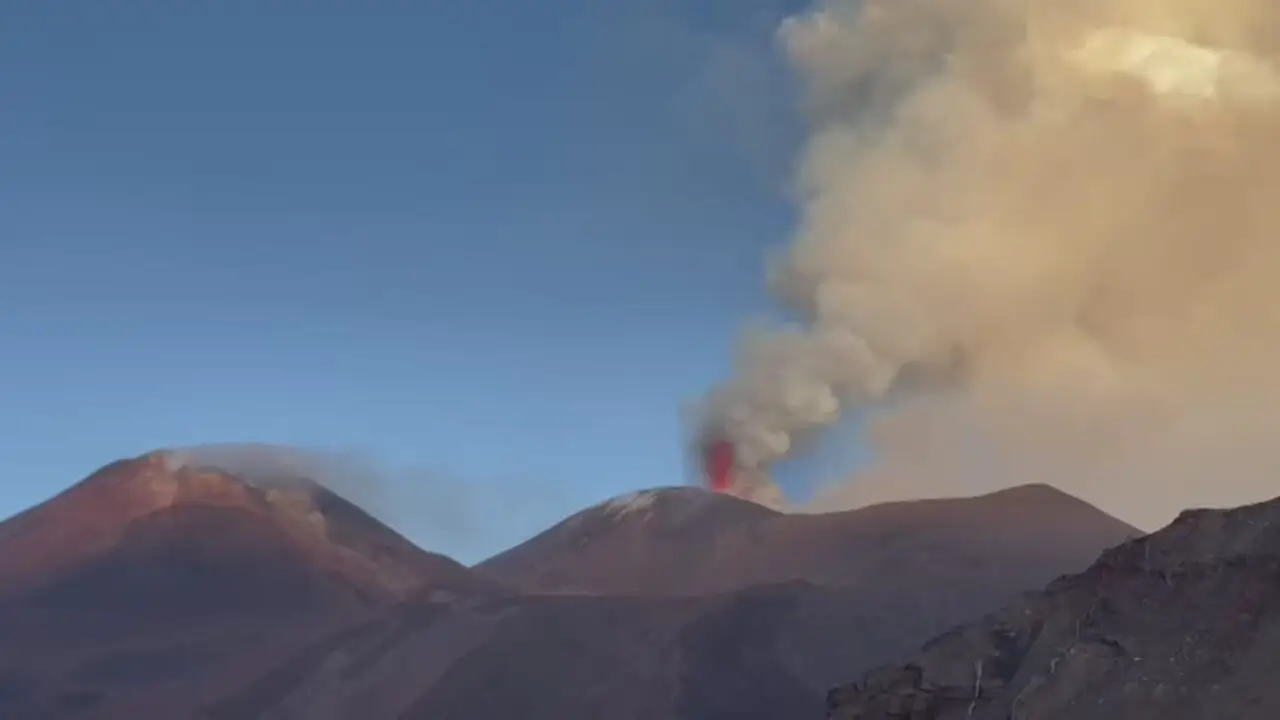
Mount Etna is erupting again. On July 30, 2026, activity at the Voragine crater escalated from strombolian explosions to a sustained lava fountain, prompting INGV to raise the aviation alert (VONA) to red. As a precaution, a sector of Catania's airspace was temporarily restricted, although the airport continued operating normally.
It was the second eruptive episode in less than a month. Earlier in July, another eruption sent an ash plume roughly 1.5 kilometres into the sky and forced the airport to reduce arrivals for much of the day.
Spectacular images of lava often dominate the headlines. Yet for the scientists and emergency teams working on the volcano, the eruption itself is only part of the challenge. The harder problem is that the landscape changes while they are trying to understand it. Monitoring an active volcano is a little like repairing a road while the asphalt is still flowing beneath your feet: the environment evolves faster than the plan you arrived with.
Every new fracture, ash cloud or lava flow changes not only what needs to be observed, but also where people can safely stand and how they remain connected to one another.
Radio propagation and real-time data flow in active eruption zones
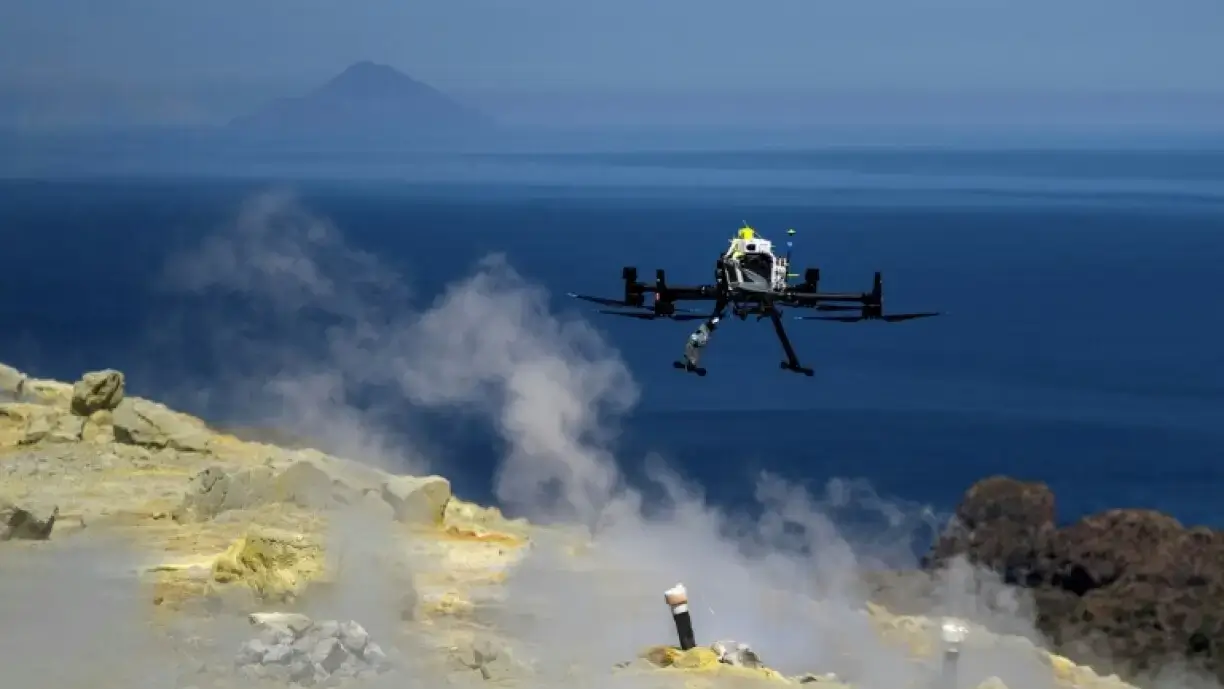
During the early July eruption, INGV field teams flew drones over the summit area to capture thermal imagery of the lava field because approaching it on foot had become too dangerous. That single decision says a great deal about what monitoring an active volcano actually involves.
As Professor Giovanni Schembra also explained in our recent interview, Mount Etna is not only a harsh environment, but often a difficult one to reach. Some areas are inaccessible by road, others become unsafe within hours, making it impossible to rely on conventional communication infrastructure alone. The challenge is therefore not simply collecting data, but bringing both connectivity and computing resources to wherever they are needed.
“We, for example, have Mount Etna here, with challenging environments that are difficult to access and completely outside the coverage of traditional 5G services. We are currently carrying out a series of tests on FANET connectivity, based on Private 5G Network technology, to enable use cases in extreme scenarios, such as providing connectivity during natural disasters.”
— Professor Giovanni Schembra, Full Professor at Univeristy of Catania
The surprising part is that collecting the data is often not the hardest task. Keeping everyone and everything connected while those measurements are being taken can be just as difficult.
Heat, ash and volcanic gases all affect radio propagation. Paths that were accessible in the morning may disappear beneath fresh lava by the afternoon. Equipment must often be relocated with little warning, and fixed communication infrastructure, even when available, cannot always be relied upon.
Meanwhile, decisions cannot wait. Ash clouds can expand within minutes, aviation alerts may change several times in a day, and teams need to exchange thermal imagery, sensor readings and situational updates in real time rather than after returning to a stable connection.
Why mesh networks fit changing environments
Most communication systems are designed around a simple assumption: the world stays still. A volcano is a reminder that reality rarely cooperates.
When people, sensors and vehicles constantly change position, the network has to adapt just as quickly. This is precisely the type of environment where a mesh network becomes valuable.
Instead of relying on a single communication path, each node can relay data through neighbouring nodes, allowing traffic to find alternative routes whenever conditions change. Imagine a group of mountaineers crossing a glacier while connected by safety ropes. If one climber changes direction to avoid a crevasse, the rest of the team naturally adjusts without breaking the chain. A mesh network behaves in much the same way, continuously adapting instead of insisting on one fixed route.
Combined with a private 5G architecture, this approach allows coverage to expand alongside the operation itself. Teams can reposition equipment, deploy additional nodes or move deeper into the affected area without rebuilding the network every time conditions change.
Drone platforms can play an equally important role. Thermal cameras and visual sensors are only useful if the information reaches decision-makers while the aircraft is still in flight, even when ridgelines, ash clouds or distance would normally interrupt communication. What emerges is a genuinely multidomain environment, where ground teams, aerial platforms and remote control rooms all depend on the same resilient communications infrastructure.
We are not suggesting that every volcano observatory should deploy a private 5G mesh network tomorrow. Rather, Etna illustrates a broader engineering lesson. Whenever the environment itself becomes unpredictable, communication systems must become adaptable as well.
Beyond Etna: adaptable connectivity for unpredictable environments
Volcanoes are an extreme example, but they are far from unique. Construction sites expand, floodwaters reshape landscapes, wildfires force emergency teams to relocate, and industrial facilities constantly evolve as operations progress.
In every one of these situations, the question is no longer "How well does our network perform under normal conditions?" A far more useful question is "What happens when the environment itself becomes part of the problem?"
Volcanoes remind us that infrastructure is only reliable for as long as the world around it behaves. The moment the landscape starts rewriting itself, connectivity has to become just as adaptable. Networks, in other words, need to learn to move with the environment they serve.
Etna is not unique. It simply makes visible a problem that exists in many remote and fast-changing environments. As Professor Schembra pointed out, when reaching the site is already difficult, expecting fixed infrastructure to be there is often unrealistic. In those situations, the network has to travel with the mission.
This is one of the challenges we are exploring at SMA-RTY: how communication architectures can adapt to changing operational scenarios, combining private 5G connectivity, mesh networking and distributed systems to support missions where traditional infrastructure cannot always be assumed.
CONTACT US if you are dealing with environments where traditional connectivity infrastructure cannot always be deployed. Understanding these challenges together helps shape communication technologies around real operational needs.