
How deployable private 5G keeps drones connected
Drones are increasingly used in search and rescue, damage assessment, environmental monitoring and other operations where people cannot easily reach the area. They can provide a view from above, collect data and help teams understand what is happening on the ground.
But all of this depends on one basic requirement: a reliable communication link between the drone and the people operating it.
The connectivity challenge for drones in emergency response
In everyday operations, drones can rely on public mobile networks, dedicated radio links or Wi-Fi. In the field, however, the available connectivity depends on the environment.
Connectivity challenges arise in several operational scenarios:
- Natural disasters: communication infrastructure may be damaged or unavailable after an earthquake or flood.
- Remote areas: public network coverage may simply not exist.
- Complex environments: ports, industrial sites, and mountainous areas often lack established infrastructure.
For emergency response teams, this creates a practical question: what happens when the connectivity needed by the drone cannot be taken for granted?
If the communication link is unreliable or unavailable, the operational value of the drone is reduced. Video feeds may become difficult to transmit, telemetry may be interrupted and the team on the ground may have less information available when making decisions.
When the network is not there, or not reliable, the drone's flight time, range, and the quality of the data it sends back are all limited, right at the moment when they matter most.
Deployable private 5G: how NGCI supports critical missions
Deployable connectivity takes a different approach: instead of adapting the mission to the infrastructure that happens to be available, the communication infrastructure can be brought to the area where it is needed.
This is the role of NGCI (Next Generation Communication Infrastructure). NGCI is SMA-RTY's standalone private 5G network, designed to be deployed on site and operate completely independently from public mobile coverage. The network can be configured for the specific environment and connected devices, from drones and sensors to the terminals used by operators on the ground.
For drone operations, this creates a dedicated communication layer between the aircraft and the team managing the mission.
NGCI does not make connectivity dependent on what is already available in the area. It brings the network into the operational scenario.
Testing drone-to-5G connectivity in real-world scenarios
This approach was also at the centre of a proposal developed by SMA-RTY together with POLITO (Politecnico di Torino) and presented by our Senior Business Developer Enzo Manco during the ToMove Sprint Dive.
The event was organised by CTE NEXT (Casa delle Tecnologie Emergenti di Torino) as part of the ToMove Living Lab, an initiative focused on testing and accelerating new technologies through experimentation in real-world contexts. The ToMove Sprint Dive brought companies, research organisations and other ecosystem partners together to explore concrete use cases and opportunities for experimentation.
Within the Use Case and Experimentation Acceleration session, Enzo presented the joint proposal developed with POLITO: to explore drone-to-5G connectivity together with Civil Protection and other emergency response organisations, bringing the technology into an operational field scenario.
The objective is not simply to demonstrate that a drone can connect to a 5G network. It is to understand how this connectivity can support the work of the people actually using the technology during an emergency response operation..
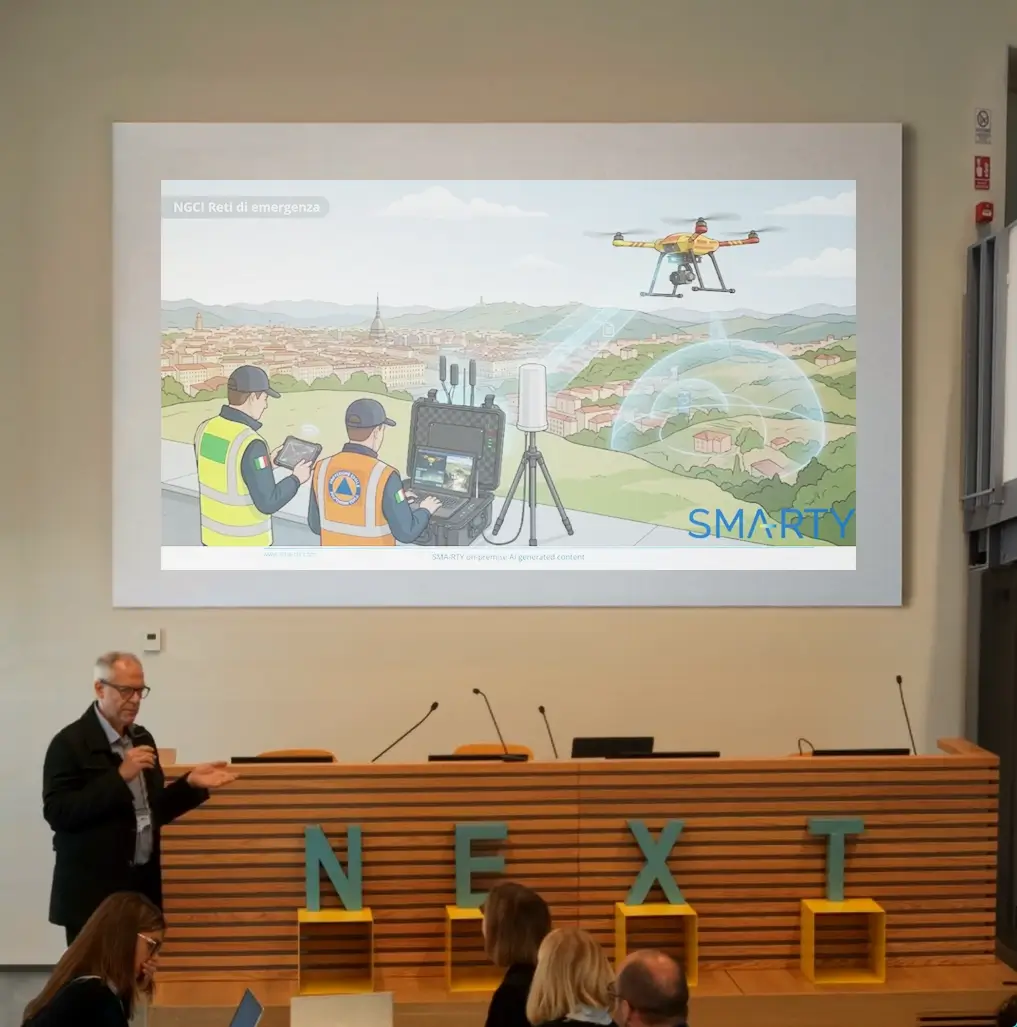
Testing private 5G for drone operations in real emergencies
NGCI has already been tested in controlled environments. The proposed field experiment with POLITO moves the focus to a different question: how can deployable private 5G support drone operations when connectivity is part of a real emergency response workflow?
Working with Civil Protection and other emergency response teams would make it possible to evaluate the technology in the context of real operational requirements:
- the area to be covered,
- the position and mobility of the drone,
- the information that needs to be exchanged,
- and the way operators interact with the network and the data it carries.
This is an important step because connectivity requirements are ultimately defined by the mission.
A drone operating above an inaccessible area requires more than generic 5G. It needs a deployable communication infrastructure that provides targeted coverage, supports high-volume data flows, and remains under the direct control of the mission team.
Why standalone 5G is the future of civil protection operations
For emergency response, the communication network is part of the operational infrastructure.
If existing public networks are available and reliable, emergency response teams can use them. However, when coverage is missing, damaged, or insufficient, a deployable private 5G network provides an alternative approach: bringing the connectivity together with the operation itself.
The proposal developed by SMA-RTY and POLITO is a step in this direction, moving drone-to-5G connectivity from a technology demonstration towards a field scenario where the requirements come directly from the people who use it.