
AI-RAN Trends 2026: Market & Technical Outlook
The radio access network (RAN), the invisible backbone that connects billions of smartphones, IoT devices, and machines to the cellular grid, is undergoing its most fundamental transformation since the dawn of mobile broadband. The catalyst? Artificial intelligence.
AI-RAN, shorthand for the integration of AI natively into Radio Access Networks, has rapidly moved from a research concept to one of the defining themes of the global telecom industry. At Mobile World Congress Barcelona 2026, it was arguably the hottest topic on the floor, managing to eclipse even Open RAN in marketing buzz, which, if you've been to MWC, is no small feat. Yet behind the excitement, though, lies a set of genuinely unresolved questions about costs, deployment models, and who ultimately benefits.
This article maps the most important trending topics shaping AI-RAN in 2026, explains why they matter for operators, vendors, and the future of connectivity, and does so without requiring a PhD in signal processing to follow along.
The Three Pillars: AI-for-RAN, AI-on-RAN, AI-and-RAN
Before diving in, a quick taxonomy. The AI-RAN Alliance, a global consortium that since its founding in 2024 has become the principal body coordinating industry thinking on the subject, defines three distinct flavors of AI integration into the RAN. Think of it like a restaurant kitchen:
- AI-for-RAN is AI working inside the kitchen machinery itself: optimizing signal processing, beamforming (how antennas aim and shape radio signals), interference management, and spectral efficiency. It makes the network smarter and more adaptive, without changing what it ultimately produces.
- AI-and-RAN is about sharing kitchen equipment. The same physical hardware, typically GPU-based accelerators, hosts both 5G radio operations and AI workloads simultaneously. During peak network hours, it runs the radio. During quieter periods, it runs AI processing. Same infrastructure, two revenue streams. Theoretically elegant.
- AI-on-RAN: is using the kitchen as a delivery service. Here, the RAN becomes a platform for running AI applications (edge AI, computer vision, industrial automation) delivered to end users via 5G connectivity. The network doesn't just carry data; it processes it, at the edge, closer to where it's needed.
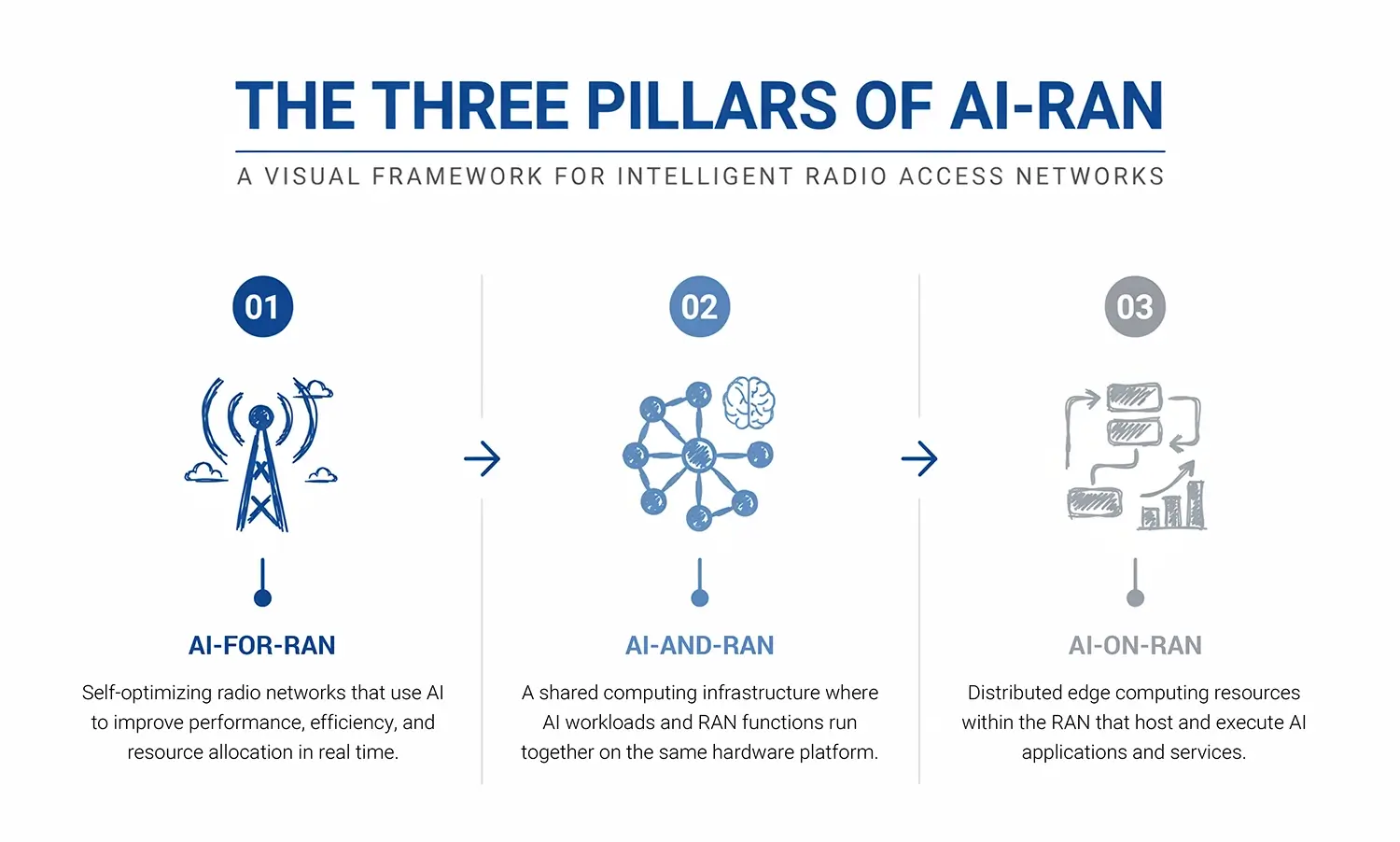
These three pillars are not mutually exclusive. In practice, the most ambitious AI-RAN deployments pursue all three simultaneously, transforming the base station from a pure communications device into a distributed, multi-purpose compute node.
The GPU-RAN Debate: Silicon at the Cell Site
Perhaps no AI-RAN question generates more debate than this one: should we put GPUs (the powerful processors that power everything from video games to large language models) inside base stations?
The case for it is compelling. Operators that can run AI workloads directly at the cell site would gain lower latency (less time for data to travel back and forth to a distant data center), better performance, and a genuinely new class of service. NVIDIA's Aerial RAN platform, for instance, provides a single GPU-accelerated infrastructure that can host 5G radio processing and AI inference simultaneously, dynamically allocating resources as demand shifts throughout the day.
NVIDIA, characteristically understated in its ambitions, announced a $2 billion partnership with Marvell Technology in early 2026 to make this infrastructure more broadly accessible, and has rallied a coalition that reads like a telecom industry family portrait: BT Group, Deutsche Telekom, Ericsson, Nokia, SK Telecom, SoftBank, T-Mobile.
The counterargument, however, is equally real. Putting GPUs in thousands of base stations is expensive, both in upfront capital and in ongoing operational costs. The current industry consensus is that this model makes economic sense only for specific, high-value locations: dense urban areas, stadiums, industrial campuses. Not across entire networks. It's a bit like buying a Ferrari for every driver in a logistics fleet: impressive in theory, financially terrifying in practice.
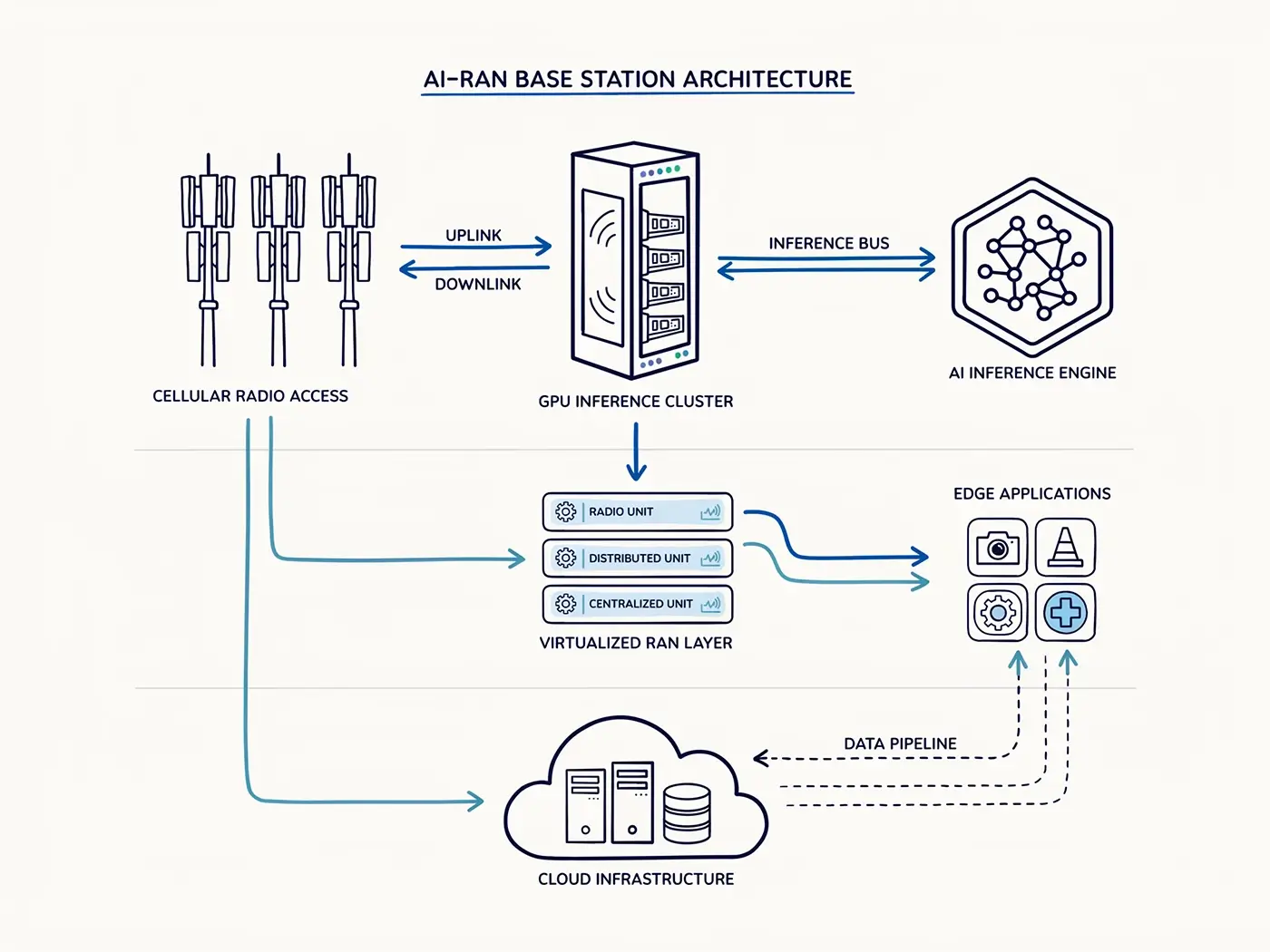
In short: GPUs are coming to the cell site, but selectively and gradually. Which, to be fair, is how most things actually happen in telecoms.
LLMs and Foundation Models: The New Brain of the Network
One of the most intellectually exciting developments in AI-RAN is the application of Large Language Models (LLMs) and foundation models to network management and optimization. LLMs are the same type of AI that powers ChatGPT and similar tools, capable of understanding natural language, reasoning across complex scenarios, and adapting to novel situations without being explicitly reprogrammed for each one.
Historically, RAN automation relied on narrow, task-specific ML models, the equivalent of hiring a series of specialists, each excellent at one thing and useless at everything else. Foundation models promise something far more powerful: a generalist intelligence that can reason across network domains, interpret configurations in plain language, and make decisions with minimal human intervention.
Practical applications already emerging include:
- Intent-based networking: instead of configuring a network with arcane technical parameters, an operator could simply say 'prioritize low-latency traffic for the industrial robots on Site A', and the LLM-powered system figures out how to make that happen across the RAN. It's essentially a natural language interface for infrastructure that previously required teams of engineers.
- Autonomous fault detection and remediation: foundation models trained on vast operational datasets can identify anomalies, predict failures before they happen, and implement corrective actions, often faster than any human team could.
- Multi-agent reinforcement learning: multiple AI agents, each managing a different slice of the network, collaborate and negotiate autonomously. Distributed intelligence that scales more naturally than centralized control, and that nobody fully understands yet, which keeps researchers employed.
The academic world has taken notice: leading IEEE journals have issued specific calls for research on AI-RAN agents based on LLMs, signaling that the research pipeline is actively filling up.
The Road to 6G: AI Built In from Day One
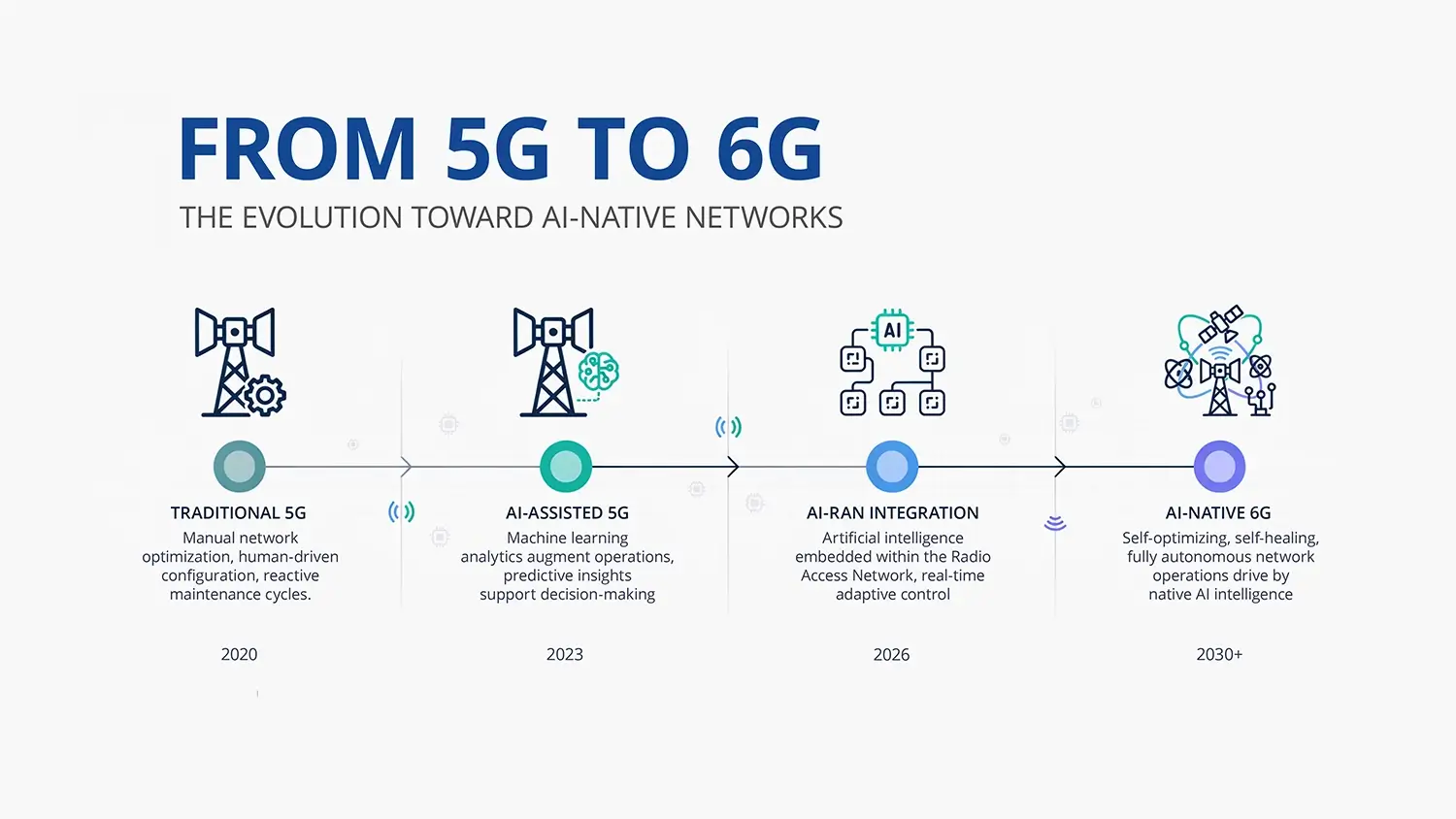
In 5G, AI arrived as an afterthought, an optimization layer bolted on top of a system that was designed without it. Think of it as retrofitting a 1970s building with smart home technology: possible, but messy and expensive, and you're always working around structural decisions made before the concept existed.
6G is meant to be different. AI will be embedded natively into the air interface (the radio communication standard between device and network), the control plane, and resource management, from the very first specification, not added in Release 47 when everyone's already deployed.
The implications are significant. An AI-native 6G network could self-configure during deployment, continuously self-optimize in real time, and self-heal after failures, without the manual radio engineering cycles that still define much of how 5G networks operate today. Emerging concepts like integrated sensing and communications (ISAC, where the network both communicates data and actively senses its environment, like radar) and non-terrestrial network integration (satellites, UAVs, high-altitude platforms) are already being prototyped.
The O-RAN Alliance's 2026 summit even adopted as its theme 'Capturing AI-Enabled Open RAN Opportunities Today and in Tomorrow's Open 6G', a title so comprehensive it presumably required its own planning committee.
Open RAN and AI: Two Revolutions Converging
Open RAN, the movement to disaggregate proprietary network hardware and software into open, interoperable components, has been reshaping the telecom vendor landscape for years. AI-RAN and Open RAN are now converging into a single architectural vision, which makes a certain logical sense: a software-defined, open network is simply more amenable to AI integration than a monolithic black box.
When network functions run as software on standard hardware, AI models can be inserted, updated, and orchestrated programmatically. Nokia's new Doksuri radios, for instance, include Open Fronthaul compatibility, an open interface standard between the radio unit and the processing unit, as a native feature. Ericsson has committed to 160 Open-RAN-proven radios by the end of 2026, while simultaneously embedding machine learning into its RAN automation platform.
The trend is clear: hardware vendors are building AI-readiness and openness as co-designed features, not competitive differentiators to be licensed separately. Progress.
Energy Efficiency: AI as the Path to Sustainable Networks
Telecom networks are extraordinarily energy-intensive infrastructure. As regulatory and competitive pressure to reduce emissions intensifies, energy efficiency has become a top-tier strategic priority, and AI-RAN offers one of the most credible paths to meaningful improvement.
AI-driven energy optimization goes well beyond simply switching off antennas at night (the telecom equivalent of turning off the lights when you leave a room). Modern ML-based approaches can predict traffic patterns hours in advance, pre-configure sleeping cells, dynamically adjust antenna parameters, and coordinate across multiple sites, all in real time, and with a granularity no human team could manage at scale.
Here, however, comes a delicious irony: running GPU workloads at the cell site consumes significant power. Balancing the energy savings from smarter network operation against the energy cost of the AI compute that makes it possible is an active area of research. AI-RAN cannot credibly claim a green credential at scale until it demonstrably saves more energy than it consumes. The jury is still out.
Edge AI: The Network as an AI Delivery Platform
One of the most commercially exciting dimensions of AI-on-RAN is the idea of the cellular network as a distributed AI delivery platform. Rather than routing AI inference requests to distant cloud data centers, introducing latency and bandwidth costs along the way, operators could serve AI applications from compute resources co-located with their base stations.
Think of it as the difference between ordering food from a restaurant across town versus having a kitchen in your building. Same result, dramatically different response time.
NVIDIA has coined the term 'AI grids' for this concept, geographically distributed, orchestrated AI infrastructure that treats radio network functions and AI inference as co-residents on shared accelerated hardware. Operators running such infrastructure could become AI-as-a-service providers for industries like manufacturing, logistics, smart cities, and healthcare, monetizing their physical network footprint in ways that pure connectivity revenue has never allowed.
The challenge is ecosystem maturity. Edge AI developers need standardized APIs, stable latency guarantees, and procurement models that don't require negotiating individually with each operator across each country. That work is ongoing but incomplete. So: genuinely promising, not quite there yet.
AI-RAN Business Case: OpEx Savings vs CapEx ROI
For all its technical promise, AI-RAN faces a fundamental commercial tension. Operators are building next-generation infrastructure while simultaneously managing slowing data traffic growth and, in many markets, significant excess network capacity.
And then there's this number, which became the most-quoted statistic at MWC 2026: according to Ericsson's June 2025 Mobility Report, GenAI currently accounts for approximately 0.06% of total network traffic. Zero point zero six.
Currently, a significantly larger proportion of GenAI app users own high-end smartphones compared to the general user base in the measured network. However, GenAI traffic represents only 0.06 percent of the total network data traffic. In most mobile networks, the typical traffic distribution is heavily skewed, with a 90-to-10 percent downlink-to-uplink ratio. However, AI traffic exhibits a higher uplink distribution, with 74 percent downlink and 26 percent uplink traffic.
Ericsson Mobility Report (June 2025)
The figure should not be interpreted as evidence that AI will have little impact on future networks. Ericsson notes that the measurement covers standalone AI applications and excludes AI features embedded within mainstream consumer services. Moreover, today's AI traffic is still dominated by relatively lightweight text and voice interactions.
However, it does highlight an important reality: the anticipated wave of AI-driven network traffic has not yet materialized at a scale that meaningfully changes operators' economics.
The business case for AI-RAN therefore rests on two very different arguments:
- Cost reduction: AI reduces the OpEx of running complex networks: less manual optimization, fewer truck rolls, and potential energy savings from more efficient network operations. This is the argument with the clearest near-term ROI, although the additional compute requirements of AI-native infrastructure may offset part of these gains.
- Revenue creation: AI-on-RAN creates new service offerings: edge inference, private AI networks, latency-sensitive enterprise services.
Both arguments are plausible. But both are also still largely hypothetical at the scale needed to justify the CapEx of AI-native infrastructure upgrades. Communications service providers (CSPs) are approaching this pragmatically: investing in AI-for-RAN optimization first (where ROI is clearest), while piloting AI-and-RAN and AI-on-RAN in controlled environments before committing to broad rollout.
The AI-RAN Alliance: Standardization and Ecosystem Momentum
The AI-RAN Alliance has become the defining institutional force in space. Founded in 2024 by NVIDIA, SoftBank, and a small group of partners, it has grown to 132 members by early 2026, including Qualcomm, SK Telecom, Vodafone, Nokia, Ericsson, and dozens of research universities. Its working groups span all three AI-RAN pillars, and it has released four foundational publications defining the building blocks of AI-powered 5G and 6G networks.
The Alliance's model, combining industry heavyweights, telecom operators, academic labs, and specialist software vendors under a shared benchmarking and blueprint framework, is helping accelerate the journey from research to deployable reference designs. At MWC 2026, its 33 live demonstrations offered the most concentrated showcase of real-world AI-RAN progress to date.
Standardization bodies are also catching up: the O-RAN Alliance and 3GPP are actively incorporating AI-native interfaces into their formal specifications, which matters because technology that isn't in the standard tends to stay proprietary, and proprietary tends to mean expensive.
Market Outlook: A Decade of Hypergrowth
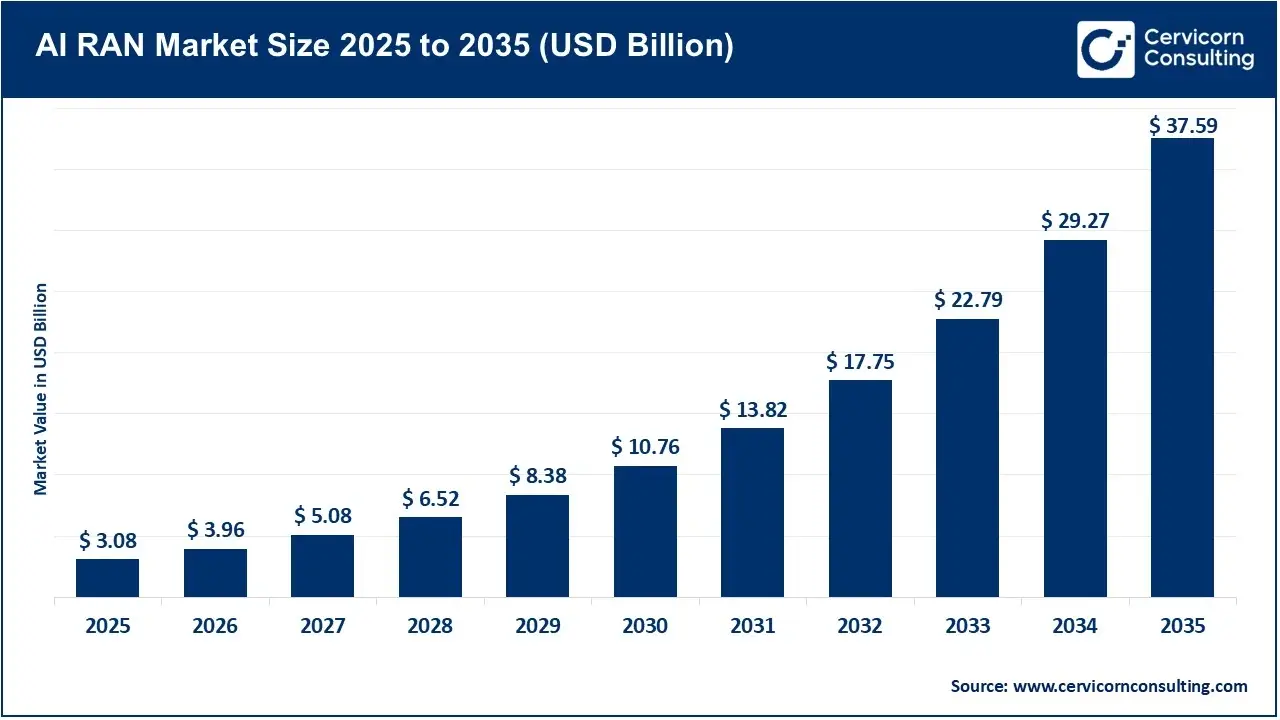
The market numbers are striking. Analysts estimate that AI-RAN is growing from approximately $3 billion in 2025 to over $37 billion by 2035, a compound annual growth rate of around 28.5%. North America currently leads adoption, driven by aggressive 5G-Advanced deployments and hyperscaler partnerships, while Asia-Pacific, led by South Korea, Japan, and China, is expected to see the fastest growth, anchored by deep government investment in 6G research and large-scale 5G rollouts in India.
The competitive landscape is consolidating around a few key ecosystems: NVIDIA's compute platform, Ericsson and Nokia on the RAN side, and a growing set of specialized AI software vendors (DeepSig, Blaize, and others) targeting specific layers of the stack.
AI-RAN Outlook: Roadmap to Commercial Deployment
AI-RAN stands at an inflection point. The industry has moved decisively past the question of whether AI belongs in the RAN. The question now is how fast, at what cost, and with what business model, which happen to be the three most difficult questions in any technology transition.
The technical foundations are solidifying: GPU-accelerated infrastructure is being validated, LLM-based network management is moving from labs to pilots, and the 6G standard is being written with AI at its core. The ecosystem is organizing: the AI-RAN Alliance has brought remarkable coordination to what could have been a fragmented space.
What remains is the hardest part: translating architectural elegance into profitable, scalable operations. The operators and vendors that solve that equation first will define the next era of wireless infrastructure.
The race is underway. The finish line is further away than the press releases suggest, but it's real.
Sources: AI-RAN Alliance, NVIDIA, Ericsson, Nokia, Dell'Oro Group, TM Forum, IEEE Communications Society, AFCEA Signal, Fierce Network, MWC Barcelona 2026.